MinuteRead
30 min
Most of us grew up believing that good work happens in teams. We picture a stable group of people who know each other well, trust one another, and have worked together long enough to anticipate each other's moves. The team has a clear roster, a shared history, and a defined purpose. This image is comforting. It suggests that if we can just assemble the right people and give them time to gel, great results will follow.
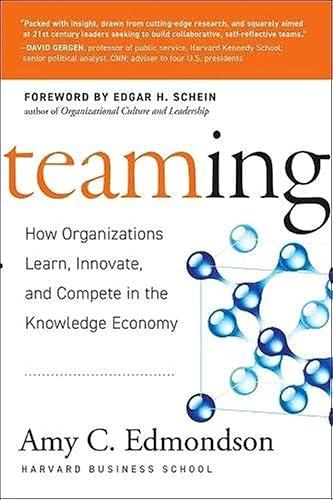
**Author:** Amy C. Edmondson
**Estimated Reading Time:** 45 minutes
**What You'll Learn:**
- Why the traditional idea of a stable team no longer fits how work actually happens - How to build psychological safety that makes honest collaboration possible - What separates organizations that learn from those that merely execute - How to match your leadership approach to the type of work you do - Practical ways to turn failure into fuel for improvement
**Who This Book Is For:**
This book is for anyone who works with other people to solve problems that do not have obvious answers. It is for managers who sense that command-and-control leadership no longer works. It is for professionals in healthcare, technology, education, and business who must coordinate across specialties, departments, and organizations. It is for leaders who want to create environments where people speak up, share ideas, and learn together rather than hide mistakes and protect turf.
Most of us grew up believing that good work happens in teams. We picture a stable group of people who know each other well, trust one another, and have worked together long enough to anticipate each other's moves. The team has a clear roster, a shared history, and a defined purpose. This image is comforting. It suggests that if we can just assemble the right people and give them time to gel, great results will follow. But this image no longer matches reality. Walk into a modern hospital emergency room and you will see physicians, nurses, technicians, and specialists who may never have worked together before, collaborating to save a patient's life. Look at a global product launch and you will find engineers in one time zone, marketers in another, and supply chain experts in a third, coordinating through video calls and shared documents. Examine a construction project and you will see architects, electricians, structural engineers, and city inspectors who belong to different companies, answer to different bosses, and must still find ways to solve problems together. These are not teams in the traditional sense. They are temporary collaborations. They form quickly, do their work, and dissolve. The people involved may never work together again. Yet the quality of their collaboration determines whether patients survive, products succeed, and buildings stand. Amy Edmondson calls this activity "teaming." She chose the word deliberately. A team is a noun, a thing, a bounded entity. Teaming is a verb, an action, a dynamic process. It is teamwork on the fly. It is the ability to coordinate and collaborate with people you may not know well, may not see often, and may not share a history with. It is the skill of building trust quickly, sharing knowledge effectively, and making decisions under…
Continue reading in the MinuteRead app
Get the complete 30-minute summary of Teaming
Get the complete summary in the appTeaming is a dynamic activity, not a static entity. It is teamwork on the fly.
The shift from execution to learning is essential for success in a complex, changing world.
Execution-as-learning integrates work and improvement. Every task is an opportunity to learn.
Match your approach to the nature of the work. Routine, complex, and innovative operations require different approaches.
Psychological safety is the foundation of effective collaboration. Without it, people stay silent and problems go unaddr
Psychological safety and accountability are complementary. High-performing teams have both.
"Teaming" is a strong fit if you want practical ideas around leadership, business, management, especially themes like teaming is a dynamic activity, not a static entity. it is teamwork on the fly; the shift from execution to learning is essential for success in a complex, changing world. The MinuteRead summary distills these concepts into a focused read, whether you're deciding whether to buy the book or applying its lessons at work.
Motivated to help readers with dynamic activity, Amy C. Edmondson wrote “Teaming” to package those ideas for a fast, focused read. In “Teaming”, Amy C. Edmondson focuses on dynamic activity. Through “Teaming”, Amy C. Edmondson distills the core ideas on leadership into lessons readers can absorb in a single short sitting. Readers turn to this work when they want Amy C. Edmondson's perspective on the subject without working through the entire original volume. Amy Claire Edmondson is an American s…
View all summaries by Amy C. EdmondsonContinue Reading
Access the complete 30-minute summary and thousands more nonfiction books in the MinuteRead app.

Continue reading the complete summary in the MinuteRead app.