MinuteRead
30 min
Book summary
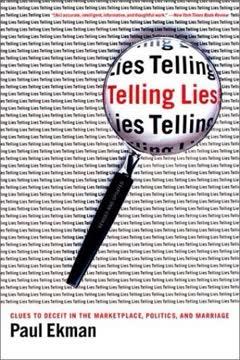
by Paul Ekman
Premium summary · Opens in the app · 30 min read
Every day, you are lied to. Some lies are small, offered as social lubrication: "You look great," "I'm fine," "That sounds wonderful." Others are larger, designed to protect secrets, avoid consequences, or gain advantage. Still others are dangerous, covering up betrayal, fraud, or harm. Yet for all the lying that surrounds us, most people are remarkably bad at knowing when they are being deceived.
**Author:** Paul Ekman
**Estimated Reading Time:** 45 minutes
**What You'll Learn:** How lies are told, why they fail, what signals betray deception, and how to think more clearly about detecting deceit in everyday life.
**Who This Book Is For:** Anyone who wants to understand the hidden dynamics of honesty and deception in relationships, work, and public life.
Every day, you are lied to. Some lies are small, offered as social lubrication: "You look great," "I'm fine," "That sounds wonderful." Others are larger, designed to protect secrets, avoid consequences, or gain advantage. Still others are dangerous, covering up betrayal, fraud, or harm. Yet for all the lying that surrounds us, most people are remarkably bad at knowing when they are being deceived. This is not because people are naive. It is because lying is woven into the fabric of social life, and because the signals that betray deception are subtle, fleeting, and often misunderstood. We are taught from childhood to accept the words people say at face value. We learn to trust. We learn to look at faces and listen to words. And liars, knowing this, learn to control exactly those channels. Paul Ekman spent decades studying the face, the voice, and the body to understand what happens when people lie. His research took him into psychiatric hospitals, police interrogation rooms, and laboratories where he filmed and analyzed thousands of expressions. He discovered that lying is not a single act but a complex performance involving cognition, emotion, and behavior. And he found that while no single clue proves deception, a careful observer can learn to spot the signs that something is being hidden. The problem Ekman addresses is not simply that lies exist. It is that most people rely on the wrong signals. They listen to words, which are the easiest thing for a liar to control. They watch the face, which is trained from childhood to display socially acceptable emotions. They ignore the voice, the body, and the tiny involuntary expressions that flash across the face in a fraction of a second. They also fail to account for their own biases, their willingness to be deceived, and the emotional pressures that shape both lying and lie catching. Ekman's approach is different because it is grounded in decades of empirical research on facial expression and emotion. He did not rely on intuition or folk wisdom. He mapped the muscles of the face, catalogued the expressions of emotion across cultures, and studied how people behave when they are trying to hide what they feel. His work revealed that the face is a dual system, capable of both deliberate expression and involuntary revelation. It also showed that lying generates emotional byproducts such as…
Continue reading in the MinuteRead app
Get the complete 30-minute summary of Telling Lies
Get the complete summary in the appLies fail because of poor planning or uncontrolled emotions.
Liars prefer concealing to falsifying.
Fear, guilt, and duping delight are the emotions that betray liars.
Words and faces are controlled; voice and body leak.
The face has voluntary and involuntary muscles.
Micro expressions reveal suppressed emotions.
"Telling Lies" is a strong fit if you want practical ideas around psychology, science, self help, especially themes like lies fail because of poor planning or uncontrolled emotions; liars prefer concealing to falsifying. The MinuteRead summary distills these concepts into a focused read, whether you're deciding whether to buy the book or applying its lessons at work.
Paul Ekman is a renowned American psychologist who pioneered the study of emotions and their relationship to facial expressions. His groundbreaking research on microexpressions and deception detection has significantly influenced fields such as psychology, law enforcement, and popular culture. Paul Ekman's work formed the basis for the TV show "Lie to Me" and has been widely recognized in academic circles. He has authored numerous books on emotions and deception, including "Telling Lies" and "Em…
View all summaries by Paul EkmanContinue Reading
Access the complete 30-minute summary and thousands more nonfiction books in the MinuteRead app.

Continue reading the complete summary in the MinuteRead app.