MinuteRead
30 min
Book summary
Premium summary · Opens in the app · 30 min read
Most of us have been taught to see the world in binaries. Right or wrong. Win or lose. Us or them. My way or your way. This either/or mindset shapes how we approach nearly every conflict, from arguments with a spouse to negotiations between nations. We assume that for one side to gain, the other must lose. We believe that the best possible outcome in any disagreement is a compromise, where both parties give up something they want and walk away mildly dissatisfied.
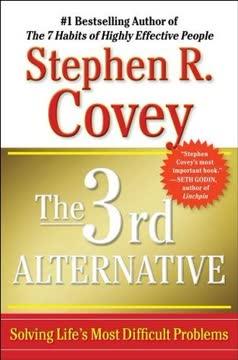
By Stephen R. Covey
**Estimated Reading Time:** 45 minutes
**What You'll Learn:** How to move beyond compromise and conflict into genuinely creative solutions that benefit everyone involved. You will discover a framework for transforming disagreements at work, at home, and in society into opportunities for breakthrough thinking.
**Who This Book Is For:** Anyone who has ever felt stuck between two bad options. Leaders facing seemingly intractable organizational problems. Parents navigating family tensions. Professionals caught in negotiation deadlocks. Citizens frustrated by polarized debates. If you have ever thought "there has to be a better way," this book is for you.
Most of us have been taught to see the world in binaries. Right or wrong. Win or lose. Us or them. My way or your way. This either/or mindset shapes how we approach nearly every conflict, from arguments with a spouse to negotiations between nations. We assume that for one side to gain, the other must lose. We believe that the best possible outcome in any disagreement is a compromise, where both parties give up something they want and walk away mildly dissatisfied. But what if that assumption is wrong? Stephen Covey spent decades studying how exceptional individuals and organizations solve problems. What he discovered is that the most effective problem solvers reject the premise of either/or thinking entirely. Instead of asking "whose solution will win?" they ask a different question: "Can we create something better than either of us has imagined yet?" This is the 3rd Alternative. The 3rd Alternative is not compromise. Compromise is simply a watered-down version of two opposing positions. It is not capitulation, where one side surrenders to the other. It is not avoidance, where problems are ignored in the hope they will disappear. The 3rd Alternative is a genuine third option, a solution that is better than what either party originally proposed. It emerges when people stop defending their positions and start exploring possibilities together. Consider a simple example. Two sisters are fighting over an orange. Each insists she needs the whole thing. The mother, applying traditional conflict resolution, cuts the orange in half. Each sister gets half. It seems fair. But what if the mother had asked each sister why she wanted the orange? She would have discovered that one sister wanted the juice to make a drink, while the other wanted the peel to bake a cake. The 3rd Alternative would have given one sister all the juice and the other all the peel. Both would have gotten everything they wanted, and more than they would have received from the compromise. This simple story illustrates a profound truth: most conflicts contain hidden opportunities for mutual gain that we never discover because we never…
Continue reading in the MinuteRead app
Get the complete 30-minute summary of The 3rd Alternative
Get the complete summary in the appThe 3rd Alternative is a solution that is better than what either side originally proposed. It is not compromise.
The belief that there are only two alternatives is a mental construct. Question it.
Inner security is the foundation. You must see yourself clearly before you can engage with others.
Other people are human beings, not objects. See them as such.
Empathic listening is the bridge to understanding. Listen to understand, not to respond.
Synergy is the process of creating something new together. One plus one can equal three.
"The 3rd Alternative" is a strong fit if you want practical ideas around self help, business, personal development, especially themes like the 3rd alternative is a solution that is better than what either side originally proposed. it is not compromise; the belief that there are only two alternatives is a mental construct. question it. The MinuteRead summary distills these concepts into a focused read, whether you're deciding whether to buy the book or applying its lessons at work.
Stephen Richards Covey was a renowned American author, educator, and businessman. His most famous work, The 7 Habits of Highly Effective People, became a global bestseller. Covey wrote several other influential books on leadership and personal development. He was recognized as one of Time magazine's 25 most influential people in 1996. Covey served as a professor at Utah State University's Jon M. Huntsman School of Business. His teachings focused on principle-centered leadership and personal effe…
View all summaries by Stephen R. CoveyContinue Reading
Access the complete 30-minute summary and thousands more nonfiction books in the MinuteRead app.

Continue reading the complete summary in the MinuteRead app.