MinuteRead
30 min
Book summary
Premium summary · Opens in the app · 30 min read
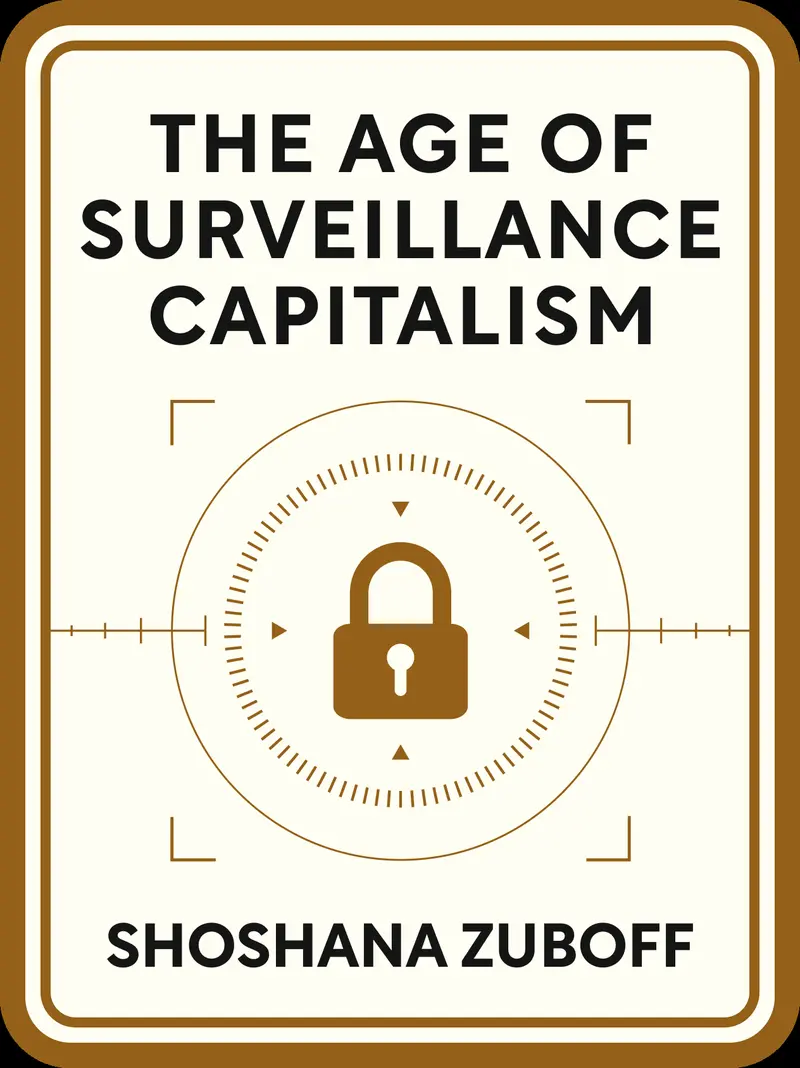
Imagine a new economic order that does not simply sell products or services but claims the most intimate territories of human life as free raw material. This order does not ask permission. It does not negotiate terms. It simply takes, analyzes, and transforms human experience into predictions that are then sold to the highest bidder. This is surveillance capitalism, and according to Shoshana Zuboff, it represents one of the most significant transformations in the history of capitalism.
**Author:** Shoshana Zuboff **Estimated Reading Time:** 45 minutes **What You'll Learn:** How a new economic logic emerged from the digital world, why it treats human experience as raw material, how it threatens individual autonomy and democracy, and what this means for the future of society. **Who This Book Is For:** Anyone who uses digital technology and wants to understand the hidden economic forces shaping their choices, attention, and behavior. This book is essential for citizens concerned about privacy, democracy, and the concentration of power in the digital age.
Imagine a new economic order that does not simply sell products or services but claims the most intimate territories of human life as free raw material. This order does not ask permission. It does not negotiate terms. It simply takes, analyzes, and transforms human experience into predictions that are then sold to the highest bidder. This is surveillance capitalism, and according to Shoshana Zuboff, it represents one of the most significant transformations in the history of capitalism. The story begins quietly, almost invisibly. In the early 2000s, a company founded on the promise of organizing the world's information made a discovery that would change everything. Google, struggling to survive the dot-com crash, found that the data left behind by users searching the internet could be repurposed. What was once considered waste, the exhaust of digital activity, could be mined for patterns. Those patterns could predict what users might click, buy, or desire. And those predictions could be sold to advertisers. This discovery was not merely a business innovation. It was the birth of a new economic logic. The company realized that human experience, in all its richness and complexity, could be claimed as raw material, translated into behavioral data, and transformed into prediction products. This logic did not stay contained within Google. It spread rapidly to Facebook, Microsoft, Amazon, and eventually to companies across every sector of the economy. What makes surveillance capitalism fundamentally different from earlier forms of capitalism is its relationship to human beings. Industrial capitalism exploited natural resources and labor. Surveillance capitalism exploits human experience itself. It claims the right to know, predict, and ultimately shape human behavior. It operates in the shadows, deliberately designed to be invisible to those it surveils. And it has grown so powerful that it now threatens the foundations of individual autonomy and democratic self-governance. The problem this book addresses is not simply about privacy. Privacy is a symptom of a deeper transformation. The real issue is power. Surveillance capitalism has created an unprecedented asymmetry of knowledge between those who collect data and those whose data is collected. This asymmetry translates into an asymmetry of power. The companies that know the most about human…
Continue reading in the MinuteRead app
Get the complete 30-minute summary of The Age of Surveillance Capitalism
Get the complete summary in the appSurveillance capitalism claims human experience as free raw material for translation into behavioral data.
Behavioral surplus is the data that exceeds what is needed to provide a service, and it is the foundation of the surveil
The prediction imperative drives constant expansion of data collection into every domain of human life.
Big Other is the invisible infrastructure of surveillance capitalism, operating through sensors, algorithms, and behavio
Surveillance capitalism has expanded from the virtual world into the physical world, commodifying reality itself.
The ultimate goal of surveillance capitalism is not prediction but action: the power to shape human behavior.
"The Age of Surveillance Capitalism" is a strong fit if you want practical ideas around politics, economics, technology, especially themes like surveillance capitalism claims human experience as free raw material for translation into behavioral data; behavioral surplus is the data that exceeds what is needed to provide a service, and it is the foundation of the surveil. The MinuteRead summary distills these concepts into a focused read, whether you're deciding whether to buy the book or applying its lessons at work.
Shoshana Zuboff is a renowned scholar and author specializing in the social and economic implications of information technology. As the Charles Edward Wilson Professor emerita at Harvard Business School, she has made significant contributions to the field through her academic work and publications. Zuboff's previous books include "In The Age of the Smart Machine" and "The Support Economy," which explore the changing nature of work and capitalism in the digital age. With a Ph.D. from Harvard Univ…
View all summaries by Shoshana ZuboffContinue Reading
Access the complete 30-minute summary and thousands more nonfiction books in the MinuteRead app.

Continue reading the complete summary in the MinuteRead app.