MinuteRead
30 min
Book summary
by George Soros
Premium summary · Opens in the app · 30 min read
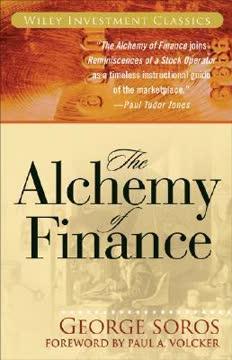
George Soros wrote The Alchemy of Finance in 1987, after decades of managing money through some of the most turbulent markets of the twentieth century. The book emerged from a simple observation that refused to go away: the theories he had learned in economics classes did not describe the markets he traded in every day.
**Author:** George Soros
**Estimated Reading Time:** 45 minutes
**What You'll Learn:**
- Why markets are never perfectly efficient and why that matters for every investor - How the feedback loop between perception and reality drives booms and busts - The mechanics of credit cycles and why they inevitably reverse - How central banks shape financial stability and why their role is misunderstood - A practical framework for thinking about markets as living, evolving systems
**Who This Book Is For:**
Investors who want to understand why markets behave irrationally. Students of economics who sense that textbook models miss something essential. Policymakers and regulators who need a realistic view of financial instability. And anyone curious about how one of the most successful investors in history actually thinks about money, markets, and human behavior.
George Soros wrote The Alchemy of Finance in 1987, after decades of managing money through some of the most turbulent markets of the twentieth century. The book emerged from a simple observation that refused to go away: the theories he had learned in economics classes did not describe the markets he traded in every day. The textbooks said markets tend toward equilibrium. They said prices reflect all available information. They said rational participants make rational decisions. Yet Soros watched markets swing from euphoria to panic. He saw prices detach from fundamentals for years at a time. He observed smart, informed people making decisions that were clearly driven by emotion, bias, and herd behavior. The disconnect was not incidental. It was fundamental. Soros came to believe that the entire edifice of modern economics rests on a flawed foundation. The flaw is not a minor technical issue. It is a deep misunderstanding of how thinking participants interact with the situations they are trying to understand. In financial markets, participants do not simply observe reality. They act on their understanding, and their actions change reality. This creates a feedback loop that standard economic models cannot capture. This insight became the foundation of Soros's investment philosophy. He called it reflexivity. It is a concept with roots in philosophy and social science, but Soros applied it with remarkable practical success. He used it to anticipate the boom-bust cycle in real estate investment trusts in the 1970s. He used it to navigate the currency crises of the 1980s. He used it to understand the rise and fall of the Japanese bubble. And in 1992, he used it to make one of the most famous trades in financial history, betting against the British pound and earning over a billion dollars in a single day. But The Alchemy of Finance is not a how-to manual for making money. It is a work of intellectual autobiography and economic…
Continue reading in the MinuteRead app
Get the complete 30-minute summary of The Alchemy of Finance
Get the complete summary in the appMarkets are inherently biased and unstable, not efficient.
Reflexivity is the two-way feedback loop between perception and reality.
Boom-bust cycles are driven by credit expansion and contraction.
Financial success depends on anticipating expectations, not on understanding truth.
The concept of equilibrium is fundamentally flawed for financial markets.
Self-reinforcing trends always reverse, and the reversal is often violent.
"The Alchemy of Finance" is a strong fit if you want practical ideas around finance, economics, business, especially themes like markets are inherently biased and unstable, not efficient; reflexivity is the two-way feedback loop between perception and reality. The MinuteRead summary distills these concepts into a focused read, whether you're deciding whether to buy the book or applying its lessons at work.
George Soros is a Hungarian-American financier and philanthropist known for his successful speculation and liberal advocacy. He gained fame as "the Man Who Broke the Bank of England" after profiting $1 billion during the 1992 Black Wednesday currency crisis. As Chairman of Soros Fund Management, LLC, his views on economic and investing matters are widely influential. Soros's financial acumen and philanthropic efforts have made him a prominent figure in global finance and politics. His success as…
View all summaries by George SorosContinue Reading
Access the complete 30-minute summary and thousands more nonfiction books in the MinuteRead app.

Continue reading the complete summary in the MinuteRead app.