MinuteRead
30 min
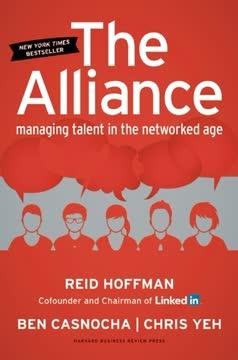
Book summary
by Reid Hoffman
Premium summary · Opens in the app · 30 min read
The Alliance lays out a path forward for companies and their employees.
**Author:** Reid Hoffman
**Estimated Reading Time:** 45 minutes
**What You'll Learn:**
- Why the traditional employment contract is broken and what should replace it - How to structure work relationships that benefit both companies and employees - The framework for building trust in an era where lifetime employment no longer exists - How to leverage employee networks and alumni relationships for mutual advantage - Practical steps for implementing a new employment model in your organization
**Who This Book Is For:**
Managers struggling to retain talented employees who seem ready to leave at any moment. Employees who want their companies to invest in their growth without feeling trapped. Founders and executives building organizations for the networked age. Anyone who suspects that treating a company like a family creates more problems than it solves.
Every employment relationship begins with a lie. The company promises lifetime employment, career growth, and a family-like culture. The employee promises loyalty, dedication, and a long-term future with the organization. Both parties know these promises are unlikely to be kept, yet the ritual continues. The company will lay people off when the market turns. The employee will leave when a better opportunity appears. And both sides will feel betrayed. This fundamental dishonesty poisons the modern workplace. It prevents companies from investing in their people because they fear the investment will walk out the door. It prevents employees from committing fully because they suspect they will be discarded when convenient. The result is a relationship built on mutual suspicion rather than mutual benefit. Reid Hoffman, co-founder of LinkedIn and one of Silicon Valley's most influential thinkers, proposes a different approach. Instead of pretending that employment is permanent, he argues that companies and employees should acknowledge reality and build a relationship based on honesty. He calls this relationship "the alliance." The alliance model recognizes that lifetime employment is dead. The days when a worker joined a company at twenty-two and retired with a gold watch at sixty-five are long gone. Economic volatility, technological disruption, and changing worker expectations have made permanent employment an impossibility for most organizations. But the end of lifetime employment does not mean the end of loyalty, trust, or mutual investment. It simply means those qualities must be built on a new foundation. The problem with the old model is not that it expected too much. It is that it expected the wrong things. It asked employees to promise something they could not deliver: a lifetime of service to a single organization. It asked companies to promise something they could not deliver: permanent employment regardless of market conditions. When these impossible promises inevitably broke, both sides felt justified in their cynicism. The alliance model asks for something…
Continue reading in the MinuteRead app
Get the complete 30-minute summary of The Alliance
Get the complete summary in the appThe traditional employment contract is broken. Lifetime employment is dead, and pretending otherwise poisons the relatio
The alliance replaces fiction with truth. Companies and employees build relationships on honest, mutually beneficial com
A tour of duty is a specific, time-bound commitment to a defined mission. It creates clarity that enables investment.
There are three types of tours: rotational for early career, transformational for mutual growth, and foundational for ke
Alignment is finding the overlap between employee aspirations and company needs. It requires honest conversation and reg
Network intelligence leverages employee networks for company benefit. It works only when employees receive value in retu
"The Alliance" is a strong fit if you want practical ideas around business, leadership, management, especially themes like the traditional employment contract is broken. lifetime employment is dead, and pretending otherwise poisons the relatio; the alliance replaces fiction with truth. companies and employees build relationships on honest, mutually beneficial com. The MinuteRead summary distills these concepts into a focused read, whether you're deciding whether to buy the book or applying its lessons at work.
Reid Hoffman is a prominent entrepreneur, executive, and investor in the tech industry. He co-founded LinkedIn and played a key role in PayPal's success. Hoffman is known for his expertise in consumer technology, network effects, and scaling businesses. He has invested in numerous influential companies and serves on various boards. As a partner at Greylock, he focuses on products with massive user potential. Hoffman has co-authored several bestselling books and hosts podcasts on entrepreneurship…
View all summaries by Reid HoffmanContinue Reading
Access the complete 30-minute summary and thousands more nonfiction books in the MinuteRead app.

Continue reading the complete summary in the MinuteRead app.