 MinuteRead
30 min
Book summary
by Cary Cooper
Premium summary · Opens in the app · 5 min read
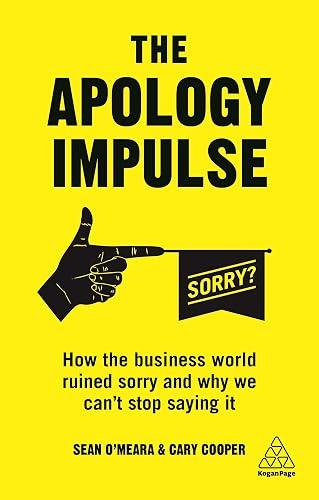
The Apology Impulse will help you and your business become more authentic in your relationships with others by identifying how much companies say sorry, why they do, how they get it wrong, and the right way to do it.
The Apology Impulse will help you and your business become more authentic in your relationships with others by identifying how much companies say sorry, why they do, how they get it wrong, and the right way to do it.
American Airlines apologized roughly 200 times per day to customers in just the first part of 2014. Were they in a terrible crisis or something? No, everything was going well. They were just saying sorry for every minor error that came up.
Companies in the same sector as American Airlines have to be careful about customer complaints. That’s because it’s easy for people to use another company when something goes wrong.
Banks, in contrast, don’t have to worry as much about customer service because it’s pretty time-consuming for people to change who they bank with.
Social media has made this even worse. People can go online and share even the smallest slip up a company does with the entire world. It also gives businesses a place to interact, which usually means they’re apologizing too often.
It might sound like a good thing that corporations are owning up to their mistakes but the reality is, it just makes the word “sorry” lose meaning.
Take the grocery chain Tesco, for example. They used the phrase “very sorry” to describe how they felt after giving a customer the wrong medication.
But by using the same words to describe a labeling error on costumes, the company diluted the meaning of “very sorry.”
If you’re going to apologize, focusing on quality over quantity has the power to improve your credibility and reputation.
I remember learning when I was young that “sorry” meant that you’ll never do it again. When you actually follow through with this, it can have dramatically positive effects on your personal and business relationships. But when you fail to follow-through and have to keep apologizing, you lose a lot of trust. Take Mark Zuckerberg, for example. In 2010 the world heard him apologize for privacy issues with the fairly new Facebook. Figuring there were just some growing pains, people forgave him. But just eight years later in 2018, he had to be saying sorry again for the same privacy problems! His lack of action made his second apology feel awfully hollow. Contrast this with the actions of JetBlue’s CEO David Neeleman after 130,000 customers experienced issues after flight disruptions. He apologized sincerely and didn’t stop with just words but then created an action plan. Sharing his “customer bill of rights” in a YouTube video, he outlined what customers would get when their flights were delayed in the future. And he took his commitment seriously by following through and making it actually happen. Starbucks…
Continue reading in the MinuteRead app
Get the complete 5-minute summary of The Apology Impulse
Get the complete summary in the appCompanies are apologizing too much and it’s ruining the word “sorry” for everybody.
If you want people to take you seriously, you have to show that you’ll change every time you say you’re sorry.
Not apologizing is sometimes the best option.
"The Apology Impulse" is a strong fit if you want practical ideas around business, career, communication skills, especially themes like companies are apologizing too much and it’s ruining the word “sorry” for everybody; if you want people to take you seriously, you have to show that you’ll change every time you say you’re sorry. The MinuteRead summary distills these concepts into a focused read, whether you're deciding whether to buy the book or applying its lessons at work.
Cary L. Cooper is the author and editor of more than 125 books and is one of Britain's most quoted business gurus. He was born in the USA, but lives in England and has dual nationality. He is Distinguished Professor of Organizational Psychology and Health at Lancaster University Management School. He is a founding President of the British Academy of Management, a Companion of the Chartered Management Institute and one of only a few UK Fellows of the (American) Academy of Management, past Preside…
View all summaries by Cary CooperContinue Reading
Access the complete 5-minute summary and thousands more nonfiction books in the MinuteRead app.

Continue reading the complete summary in the MinuteRead app.






