MinuteRead
30 min
Book summary
Premium summary · Opens in the app · 30 min read
Most books about technical analysis promise something they cannot deliver. They show you charts with perfectly drawn trendlines, indicators that called every major turn, and patterns that seem to jump off the page. They imply that if you simply learn to recognize these formations, you will be able to predict market movements with confidence.
**Author:** Adam H. Grimes
**Estimated Reading Time:** 45 minutes
**What You'll Learn:**
- Why markets are random most of the time, and where genuine trading edges actually come from - How to read price action and market structure like a professional - The four trade setups that encompass every technical trade imaginable - How to use indicators intelligently without falling into common traps - The psychological forces that cause most traders to fail, and how to overcome them - A practical framework for developing intuition and achieving consistency
**Who This Book Is For:**
- Traders who have struggled with inconsistent results and want a deeper understanding of how markets actually work - Investors looking to add technical analysis to their decision-making toolkit - Anyone who has tried trading with indicators and patterns but found them unreliable - Experienced traders seeking a rigorous, scientific framework for refining their edge
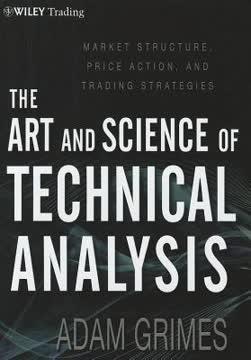
Most books about technical analysis promise something they cannot deliver. They show you charts with perfectly drawn trendlines, indicators that called every major turn, and patterns that seem to jump off the page. They imply that if you simply learn to recognize these formations, you will be able to predict market movements with confidence. Then you open a live chart and discover that reality looks nothing like the textbook examples. The trendlines are ambiguous. The patterns are messy. The indicators give conflicting signals. And the trades you take based on what you learned seem to fail more often than they succeed. This is not because you are bad at technical analysis. It is because most technical analysis education is fundamentally flawed. It teaches you to see patterns that are often illusions, to trust indicators that are simply mathematical transformations of price, and to believe that markets are more predictable than they actually are. Adam Grimes wrote The Art and Science of Technical Analysis to address this gap between how technical analysis is taught and how markets actually behave. His approach is different from the start. He does not promise certainty. He does not offer a magic indicator or a secret pattern. Instead, he builds a framework for understanding markets as they actually are: complex, noisy, and largely random, but with small pockets of predictability that skilled traders can exploit. The central problem Grimes addresses is that most traders approach the market with the wrong expectations. They expect to be right most of the time. They expect patterns to work reliably. They expect indicators to tell them what will happen next. When these expectations inevitably fail, they blame themselves, or they search for a better indicator, or they give up entirely. The truth is more subtle and more interesting. Markets are not completely…
Continue reading in the MinuteRead app
Get the complete 30-minute summary of The Art and Science of Technical Analysis
Get the complete summary in the appEvery edge comes from an imbalance between buying and selling pressure.
Markets are random most of the time. Your job is to find the moments when they are not.
Price action is the dynamic interplay of motive and resistive forces.
Market structure is the static record of that interplay.
The Wyckoff cycle has four phases: accumulation, markup, distribution, markdown.
Every technical trade falls into one of four setups.
"The Art and Science of Technical Analysis" is a strong fit if you want practical ideas around finance, business, economics, especially themes like every edge comes from an imbalance between buying and selling pressure; markets are random most of the time. your job is to find the moments when they are not. The MinuteRead summary distills these concepts into a focused read, whether you're deciding whether to buy the book or applying its lessons at work.
Adam Grimes is a respected figure in the world of technical analysis and trading. Adam Grimes is known for his no-nonsense approach to trading education, emphasizing a scientific and pragmatic methodology. He has authored "The Art and Science of Technical Analysis," which has received widespread acclaim from traders and investors. Grimes is recognized for his ability to explain complex trading concepts in an accessible manner, making his work valuable for both beginners and experienced traders. …
View all summaries by Adam H. GrimesContinue Reading
Access the complete 30-minute summary and thousands more nonfiction books in the MinuteRead app.

Continue reading the complete summary in the MinuteRead app.