MinuteRead
30 min
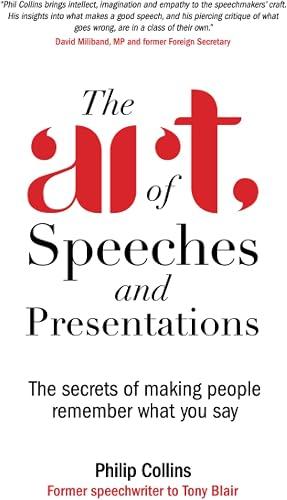
Book summary
by Philip Collins
Premium summary · Opens in the app · 30 min read
There is a moment before every speech when the speaker looks out at the waiting faces and feels the weight of expectation settle upon them. Some people experience this as terror. Others feel excitement. Most feel some mixture of both. But nearly everyone shares a common fear: the fear of being exposed as inadequate, of opening their mouth and discovering that the words will not come, or worse, that the words will come but no one will care.
**Author:** Philip Collins **Estimated Reading Time:** 42 minutes
**What You'll Learn:** How to craft speeches that connect with audiences, persuade effectively, and sound authentically like you. You will learn the complete process from first idea to final delivery, including audience analysis, argument construction, language mastery, and performance preparation.
**Who This Book Is For:** Anyone who has ever stood before an audience with something important to say. Whether you lead teams, pitch ideas, teach students, deliver eulogies, or simply want to express yourself more persuasively in meetings, this book will transform how you prepare and deliver spoken words.
There is a moment before every speech when the speaker looks out at the waiting faces and feels the weight of expectation settle upon them. Some people experience this as terror. Others feel excitement. Most feel some mixture of both. But nearly everyone shares a common fear: the fear of being exposed as inadequate, of opening their mouth and discovering that the words will not come, or worse, that the words will come but no one will care. Philip Collins has spent his professional life standing at the intersection of language and power. As a speechwriter for Tony Blair during his years as Prime Minister, Collins learned that the difference between a speech that moves nations and one that disappears without trace is rarely a matter of natural talent. It is a matter of craft. The great speeches of history were not spontaneous eruptions of genius. They were built, word by word, with patience and precision, by people who understood that speaking is an art that can be learned. The problem most people face is not that they lack something to say. It is that they have never been taught how to say it. Schools teach us to write essays. Universities teach us to write papers. Employers teach us to write reports. But almost no one teaches us how to write for the human voice, for the ear rather than the eye, for the moment of live delivery rather than the quiet page. We are trained to communicate in writing and then thrown into situations where we must communicate in speech, as if the two were the same thing. They are not. A written document can be reread. A speech happens once. A written document can contain complex sentences that the reader can pause to untangle. A speech must be understood immediately, in real time, by people who cannot rewind. A written document speaks to one reader at a time. A speech speaks to a room full of individuals, each bringing their own expectations, biases, and attention spans. The rules are different. The craft is different. And once you understand this, everything changes.…
Continue reading in the MinuteRead app
Get the complete 30-minute summary of The Art of Speeches and Presentations
Get the complete summary in the appKnow your audience before you write a single word.
Define your purpose: inform, persuade, or inspire.
Distill your main argument to one clear sentence.
Write for the ear, not the eye.
Sound like yourself, not like someone else.
Rehearse until the speech feels natural.
"The Art of Speeches and Presentations" is a strong fit if you want practical ideas around self help, business, writing, especially themes like know your audience before you write a single word; define your purpose: inform, persuade, or inspire. The MinuteRead summary distills these concepts into a focused read, whether you're deciding whether to buy the book or applying its lessons at work.
Motivated to help readers with the more you can learn about your audience, Philip Collins wrote “The Art of Speeches and Presentations” to package those ideas for a fast, focused read. In “The Art of Speeches and Presentations”, Philip Collins focuses on the more you can learn about your audience. Through “The Art of Speeches and Presentations”, Philip Collins distills the core ideas on self help into lessons readers can absorb in a single short sitting. Readers turn to this work when they want …
Continue Reading
Access the complete 30-minute summary and thousands more nonfiction books in the MinuteRead app.

Continue reading the complete summary in the MinuteRead app.