MinuteRead
30 min
Book summary
Premium summary · Opens in the app · 30 min read
We live in a world that demands certainty. Politicians are expected to have clear answers. Doctors are pressed for definitive diagnoses. Financial advisors are asked which investments will perform best. Scientists are urged to say whether a treatment works or a climate model is correct. The pressure to know, to predict, to guarantee, surrounds us constantly.
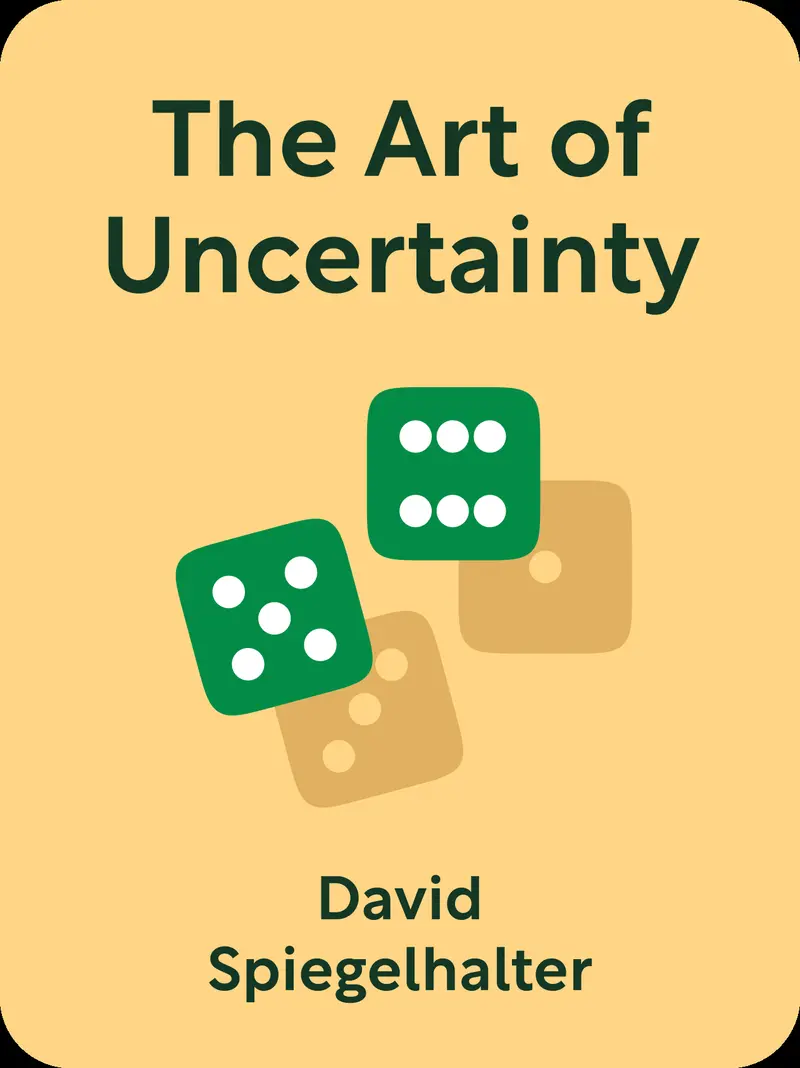
**Author:** David Spiegelhalter
**Estimated Reading Time:** 45 minutes
**What You'll Learn:**
- Why uncertainty is not a flaw in knowledge but a relationship between you and the world - How to quantify uncertainty honestly using probability and scoring rules - Why coincidences are far more common than intuition suggests - How Bayesian thinking transforms the way you update beliefs - What separates genuine expertise from confident ignorance - How to communicate uncertainty clearly in a world that demands certainty
**Who This Book Is For:**
Anyone who has ever felt paralyzed by an important decision, confused by conflicting expert opinions, or frustrated by the gap between what we know and what we need to know. This book is for people who want to think more clearly about chance, risk, prediction, and the limits of knowledge.
We live in a world that demands certainty. Politicians are expected to have clear answers. Doctors are pressed for definitive diagnoses. Financial advisors are asked which investments will perform best. Scientists are urged to say whether a treatment works or a climate model is correct. The pressure to know, to predict, to guarantee, surrounds us constantly. Yet the uncomfortable truth is that almost nothing in life is certain. The future resists prediction. The past resists perfect explanation. The present resists complete understanding. We navigate a fog of probabilities, possibilities, and unknowns, often pretending the fog is not there. This pretense creates real problems. When we ignore uncertainty, we make brittle decisions that collapse when reality surprises us. When we hide uncertainty, we erode trust in institutions and experts. When we fear uncertainty, we become vulnerable to anyone who offers false confidence, whether that person is a charismatic leader, a slick salesperson, or a self-assured pundit. David Spiegelhalter has spent his career thinking about uncertainty. As the Winton Professor of the Public Understanding of Risk at the University of Cambridge, he has worked on clinical trials, drug safety assessments, performance monitoring in medicine, and public inquiries into hospital failures. He has seen firsthand what happens when uncertainty is ignored, misunderstood, or deliberately concealed. His central insight is both simple and profound: uncertainty is not a property of the world. It is a relationship between a person and the world. What is uncertain to you may be perfectly clear to someone else. What seems impossible today may become probable tomorrow as new information arrives. Uncertainty is not a fixed state but a dynamic, personal, and evolving condition. This perspective changes everything. If uncertainty is a relationship, then we can improve that relationship. We can learn to express uncertainty more precisely. We can develop tools for updating our beliefs when evidence changes. We can distinguish between situations where uncertainty…
Continue reading in the MinuteRead app
Get the complete 30-minute summary of The Art of Uncertainty
Get the complete summary in the appUncertainty is a relationship between you and the world, not a property of the world.
Express uncertainty with numbers, not vague words.
Most people are overconfident; track your predictions and calibrate your judgment.
Coincidences happen more often than you think because of the Law of Truly Large Numbers.
True randomness is clumpy; do not see patterns where none exist.
Use Bayesian thinking to update your beliefs when new evidence arrives.
"The Art of Uncertainty" is a strong fit if you want practical ideas around science, psychology, mathematics, especially themes like uncertainty is a relationship between you and the world, not a property of the world; express uncertainty with numbers, not vague words. The MinuteRead summary distills these concepts into a focused read, whether you're deciding whether to buy the book or applying its lessons at work.
Sir David Spiegelhalter is a distinguished statistician and academic, holding the position of Winton Professor of the Public Understanding of Risk at the University of Cambridge since 2007. His expertise lies in medical statistics, with a focus on Bayesian methods. Spiegelhalter led the development of BUGS software, a crucial tool for modern Bayesian analysis. His work spans clinical trials, drug safety, and health technology assessment. He has collaborated with pharmaceutical companies and orga…
View all summaries by David SpiegelhalterContinue Reading
Access the complete 30-minute summary and thousands more nonfiction books in the MinuteRead app.

Continue reading the complete summary in the MinuteRead app.