MinuteRead
30 min
Every day, you make thousands of decisions. Most are small. What to eat. What to wear. Which email to answer first. But some are large. Should I quit my job? Is this relationship working? How do I lead my team through a crisis? What should I do with my life?
**Author:** Mikael Krogerus
**Estimated Reading Time:** 45 minutes
**What You'll Learn:**
How to use fifty of the world's most powerful decision-making models to think more clearly, understand yourself and others better, and make wiser choices in every area of life.
**Who This Book Is For:**
Anyone who has ever felt stuck in a decision, overwhelmed by complexity, or curious about how successful people structure their thinking. Whether you are leading a team, navigating a career change, or simply trying to understand why you keep making the same mistakes, this book gives you a toolkit for clearer thought.
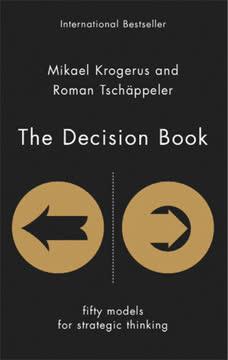
Every day, you make thousands of decisions. Most are small. What to eat. What to wear. Which email to answer first. But some are large. Should I quit my job? Is this relationship working? How do I lead my team through a crisis? What should I do with my life? The strange thing is that most of us approach both small and large decisions the same way: we rely on intuition, habit, or the advice of whoever happens to be nearby. We rarely pause to consider how we are thinking. We rarely ask whether there is a better way to structure the problem in front of us. This is where models come in. A model is not a rule. It is not a formula that tells you what to do. A model is a tool for thinking. It simplifies a complex situation by focusing your attention on the variables that matter most. It gives you a framework for organizing information, identifying patterns, and generating insights that might otherwise remain invisible. Mikael Krogerus and Roman Tschäppeler created The Decision Book to collect fifty of the most useful models from psychology, economics, management, and philosophy. The book is deliberately small. Each model gets just a few pages. But the cumulative effect is powerful: by the end, you have a mental toolkit that you can apply to almost any situation. The key insight of the book is simple but profound. Models do not define what or how you should think. They are the result of an active thought process. A model is not a substitute for thinking. It is a starting point for thinking more clearly. This matters because the world is becoming more complex, not less. The amount of information available to us doubles every few years. The number of decisions we face each day has multiplied. The consequences of those decisions ripple outward in ways we cannot always predict. Without tools for managing this complexity, we become overwhelmed. We default to reactive thinking. We confuse urgency with importance. We repeat the same mistakes. The models in this book offer an alternative. They give you…
Continue reading in the MinuteRead app
Get the complete 30-minute summary of The Decision Book
Get the complete summary in the appModels are tools for thinking, not rules to follow.
Distinguish between urgency and importance. Focus on what matters, not just what is loud.
Seek feedback to discover your blind spots.
Match challenge to skill to achieve flow.
Stop dreaming about potential. Start taking action today.
Understand the values of others to communicate better.
"The Decision Book" is a strong fit if you want practical ideas around business, self help, psychology, especially themes like models are tools for thinking, not rules to follow; distinguish between urgency and importance. focus on what matters, not just what is loud. The MinuteRead summary distills these concepts into a focused read, whether you're deciding whether to buy the book or applying its lessons at work.
Mikael Krogerus is a versatile writer with experience in journalism and advertising. He worked as a staff writer for NZZ FOLIO, the supplement magazine of Switzerland's leading newspaper, Neue Zürcher Zeitung, for five years. Prior to that, he was a copywriter for various advertising agencies. Krogerus is a graduate of the Kaospilot School and currently works as a freelance writer for German and Swiss newspapers and magazines. Despite being a Finnish citizen, he was raised in Sweden and Germany,…
View all summaries by Mikael KrogerusContinue Reading
Access the complete 30-minute summary and thousands more nonfiction books in the MinuteRead app.

Continue reading the complete summary in the MinuteRead app.