 MinuteRead
30 min
Book summary
Premium summary · Opens in the app · 30 min read
Every company wants loyal customers. The logic seems simple enough. Treat people well, exceed their expectations, and they will reward you with repeat business, positive word of mouth, and a relationship that grows more valuable over time. This belief has driven decades of investment in customer service programs, loyalty initiatives, and experience design. Companies have built elaborate training programs, hired consultants, and poured millions into technology, all in pursuit of the delighted cus
**Author:** Matthew Dixon
**Estimated Reading Time:** 45 minutes
**What You'll Learn:**
* Why most customer service investments are wasted on the wrong goal * The real driver of customer loyalty and how to measure it * How to reduce customer effort across every channel * What separates high-performing service reps from average ones * How to build a service organization that customers actually want to use
**Who This Book Is For:**
This book is for leaders and practitioners in customer service, customer experience, operations, and any role that touches the customer journey. It is for anyone who has ever wondered why satisfaction scores look good while customer churn remains stubbornly high. It is for the executive who suspects that delighting customers is an expensive myth, and for the frontline manager who wants to give their team something more useful than a script.
Every company wants loyal customers. The logic seems simple enough. Treat people well, exceed their expectations, and they will reward you with repeat business, positive word of mouth, and a relationship that grows more valuable over time. This belief has driven decades of investment in customer service programs, loyalty initiatives, and experience design. Companies have built elaborate training programs, hired consultants, and poured millions into technology, all in pursuit of the delighted customer. There is just one problem. The data does not support the strategy. When researchers examined actual customer behavior across industries, they discovered something uncomfortable. Customer service interactions are far more likely to destroy loyalty than to build it. In fact, any given service interaction is four times more likely to drive disloyalty than loyalty. Customers who contact a company for help are not looking to fall in love. They are looking to solve a problem and get back to their lives. When that process is difficult, frustrating, or time-consuming, they remember. And they leave. This finding challenges the core assumption that has guided customer experience work for years. The goal of service, according to the conventional wisdom, is to create positive emotional connections. Surprise and delight. Go above and beyond. Turn customers into advocates. But the research tells a different story. The customers who become disloyal are not the ones who failed to receive a surprise upgrade or a personalized birthday card. They are the ones who had to call three times to fix a billing error. They are the ones who were transferred from department to department, repeating their account number to each new agent. They are the ones who spent twenty minutes navigating a self-service portal only to end up on the phone anyway. The problem is not that companies are failing to delight. The problem is that companies are failing to make…
Continue reading in the MinuteRead app
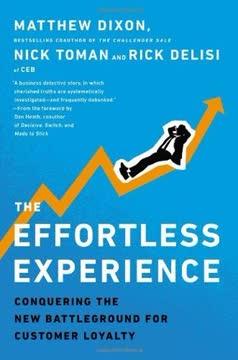
Get the complete 30-minute summary of The Effortless Experience
Get the complete summary in the appService interactions are four times more likely to drive disloyalty than loyalty.
The primary goal of customer service is to reduce effort, not create delight.
Effort has two components: rational effort and emotional effort.
Most customers prefer self-service, but only when it works.
Failed self-service attempts create some of the highest-effort experiences.
Companies must address adjacent issues to prevent repeat contacts.
"The Effortless Experience" is a strong fit if you want practical ideas around business, professional development, leadership, especially themes like service interactions are four times more likely to drive disloyalty than loyalty; the primary goal of customer service is to reduce effort, not create delight. The MinuteRead summary distills these concepts into a focused read, whether you're deciding whether to buy the book or applying its lessons at work.
Matthew Dixon is a renowned business author and researcher specializing in customer experience and sales strategy. He co-authored "The Effortless Experience" and other influential books like "The Challenger Sale" and "The Challenger Customer." Dixon's work is characterized by its data-driven approach, challenging conventional wisdom in customer service and sales. His research often focuses on improving customer loyalty and sales effectiveness through innovative strategies. Dixon's background inc…
View all summaries by Matthew DixonContinue Reading
Access the complete 30-minute summary and thousands more nonfiction books in the MinuteRead app.

Continue reading the complete summary in the MinuteRead app.






