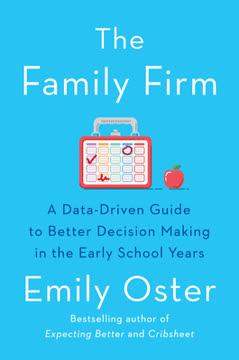
MinuteRead
30 min
Book summary
by Emily Oster
Premium summary · Opens in the app · 30 min read
Parenting often feels like navigating a vast ocean without a compass. Every day brings decisions that seem simultaneously mundane and monumental. Should my child play travel soccer? Is this the right school? How much screen time is too much? What time should bedtime be? The questions pile up, and with them comes a familiar companion: guilt. The nagging sense that somewhere, somehow, another parent is making better choices, and your children will pay the price for your mistakes.
**Author:** Emily Oster
**Estimated Reading Time:** 45 minutes
**What You'll Learn:** A complete framework for making deliberate, data-informed decisions about your family life, from sleep and nutrition to school choice and extracurricular activities. You will learn how to build your family's Big Picture, establish guiding principles, and use a structured decision-making process that replaces anxiety with clarity.
**Who This Book Is For:** Parents of school-age children who feel overwhelmed by the volume and stakes of family decisions. If you have ever wondered whether you are making the right call on bedtime, screen time, school enrollment, or how to balance work and parenting, this book provides the tools to think through those questions with confidence.
Parenting often feels like navigating a vast ocean without a compass. Every day brings decisions that seem simultaneously mundane and monumental. Should my child play travel soccer? Is this the right school? How much screen time is too much? What time should bedtime be? The questions pile up, and with them comes a familiar companion: guilt. The nagging sense that somewhere, somehow, another parent is making better choices, and your children will pay the price for your mistakes. This anxiety is not surprising. Modern parenting has become a high-stakes enterprise. The messages we receive from media, from other parents, and from the broader culture suggest that every decision carries enormous weight. One wrong move and your child might fall behind academically, socially, or emotionally. The pressure to optimize every aspect of family life is relentless. Emily Oster entered this conversation with her previous books, Expecting Better and Cribsheet, which applied economic thinking to pregnancy and early childhood. In The Family Firm, she extends that approach to the school-age years, roughly ages five through twelve. Her central argument is both simple and radical: there is no substitute for thinking. Not rules. Not checklists. Not what the mom in the pickup line told you. Just deliberate, structured thinking. Oster is not a parenting guru. She is an economist at Brown University who specializes in health economics and research methodology. Her professional life revolves around evaluating evidence, understanding data, and making decisions under uncertainty. When she became a parent, she noticed something peculiar. The same analytical tools she used in her research were almost entirely absent from parenting culture. Instead, she found a world dominated by strong opinions, weak evidence, and enormous pressure to conform. The Family Firm proposes a different approach. It treats the family as an organization, a small firm that requires management, strategy, and deliberate decision-making. This is not about turning your home into a corporation. It is about recognizing that families, like businesses, face complex choices with long-term consequences. And like businesses, families benefit from…
Continue reading in the MinuteRead app
Get the complete 30-minute summary of The Family Firm
Get the complete summary in the appCreate a written Big Picture that captures your family's values, constraints, and guiding principles. Use it as the touc
Use the Four Fs for any important decision: Frame the Question, Fact-Find, Final Decision, and Follow-Up.
Protect sleep above almost everything else. It is the foundation for cognitive function, emotional regulation, and famil
Make work decisions based on your family's specific circumstances, not on guilt. The research does not support the fear
Choose schools based on fit, not prestige. Visit, observe, and evaluate against your Big Picture rather than test scores
Limit activities to what your child genuinely enjoys and your family can sustain. More is not better.
"The Family Firm" is a strong fit if you want practical ideas around parenting, family, childrens, especially themes like create a written big picture that captures your family's values, constraints, and guiding principles. use it as the touc; use the four fs for any important decision: frame the question, fact-find, final decision, and follow-up. The MinuteRead summary distills these concepts into a focused read, whether you're deciding whether to buy the book or applying its lessons at work.
Emily Oster is an American economist and bestselling author known for her data-driven approach to pregnancy and parenting. She holds a Ph.D. from Harvard and is currently a Professor of Economics at Brown University. Oster's research focuses on development economics, health economics, and research methodology. She gained popularity with her books "Expecting Better" and "Cribsheet," which challenge conventional parenting wisdom using statistical analysis. The Family Firm is her third book, applyi…
View all summaries by Emily OsterContinue Reading
Access the complete 30-minute summary and thousands more nonfiction books in the MinuteRead app.

Continue reading the complete summary in the MinuteRead app.