MinuteRead
30 min
We like to believe that success is earned. That if you work hard enough, if you are talented enough, if you persist long enough, the world will eventually recognize your worth. It is a comforting story. It suggests that the universe is fair, that merit rises to the top, that the best ideas win.
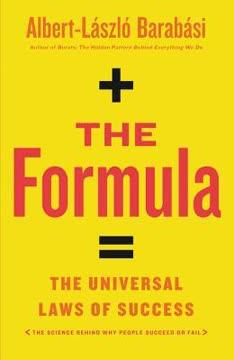
**THE FORMULA**
*The Universal Laws of Success*
By Albert-László Barabási
**Estimated Reading Time:** 45 minutes
**What You'll Learn**
Why talent and hard work are not enough. How success actually works in the real world. The hidden forces that determine who gets recognized, rewarded, and remembered. The mathematical patterns behind achievement, fame, and influence. How to apply these principles to your own life and career.
**Who This Book Is For**
Anyone who has ever wondered why brilliant people sometimes fail while ordinary people sometimes succeed. Professionals who want to understand how recognition actually works. Creators, entrepreneurs, scientists, and artists who want their work to matter. Leaders who want to build successful teams and understand why credit flows the way it does.
We like to believe that success is earned. That if you work hard enough, if you are talented enough, if you persist long enough, the world will eventually recognize your worth. It is a comforting story. It suggests that the universe is fair, that merit rises to the top, that the best ideas win. Albert-László Barabási spent his career studying networks. He mapped the hidden connections that govern how information spreads, how diseases propagate, how the internet organizes itself. He discovered that many complex systems follow surprisingly simple mathematical rules. And then he turned his attention to a question that had always fascinated him: why do some people succeed while others, equally talented, do not? What he found was unsettling and liberating in equal measure. Success, it turns out, is not a simple function of performance. It is not a meritocracy in any pure sense. The relationship between how good you are and how successful you become is far more complicated than we want to admit. And it follows patterns. Patterns that can be studied, understood, and, to some degree, influenced. The problem is that most of us operate with a broken model of success. We assume that if we improve our skills, work harder, and produce better work, recognition will follow naturally. But the data tells a different story. In many fields, performance and success are only loosely connected. The best product does not always win. The most talented artist does not always get discovered. The hardest-working employee does not always get promoted. This book exists because Barabási wanted to understand why. He assembled a team of researchers and spent years analyzing massive datasets: millions of scientific papers, hundreds of thousands of artists, the careers of professional athletes, the sales figures of books, the listening patterns of music fans. He looked for patterns. And what he found was that success, despite its apparent randomness, follows predictable laws. The topic matters because success shapes our lives in profound ways. It…
Continue reading in the MinuteRead app
Get the complete 30-minute summary of The Formula
Get the complete summary in the appSuccess is a collective phenomenon. It is about how others perceive and value your work, not just about your performance
Performance is bounded, but success is unbounded. Small performance differences can lead to enormous success differences
In measurable fields, performance drives success. In immeasurable fields, networks drive success.
Future success equals previous success multiplied by fitness. You need both initial recognition and underlying quality.
Credit is based on perception, not performance. Visibility and reputation determine who gets recognized.
The myth of the lone genius is wrong. Nearly all significant achievements are the product of networks.
"The Formula" is a strong fit if you want practical ideas around business, self help, psychology, especially themes like success is a collective phenomenon. it is about how others perceive and value your work, not just about your performance; performance is bounded, but success is unbounded. small performance differences can lead to enormous success differences. The MinuteRead summary distills these concepts into a focused read, whether you're deciding whether to buy the book or applying its lessons at work.
Albert-László Barabási is a renowned physicist and network scientist. Born in Transylvania, he obtained his Ph.D. from Boston University. Barabási is known for discovering scale-free networks and developing the Barabási-Albert model. He holds professorships at Northeastern University and Harvard Medical School, directing the Center for Complex Network Research. Barabási has authored six books, including "The Formula: The Science of Success." His work has earned him numerous awards and fellowship…
View all summaries by Albert-László BarabásiContinue Reading
Access the complete 30-minute summary and thousands more nonfiction books in the MinuteRead app.

Continue reading the complete summary in the MinuteRead app.