 MinuteRead
30 min
Book summary
by Gary Hamel
Premium summary · Opens in the app · 30 min read
Management innovation has a unique capacity to create a long-term advantage for your company.
**By Gary Hamel**
**Estimated Reading Time:** 48 minutes
**What You'll Learn** Why the most durable competitive advantage comes not from better products or operations, but from reinventing how you mobilize talent, allocate resources, and make decisions. You will learn how to challenge the management orthodoxies holding your organization back, where to find inspiration for new management principles, and how companies like Whole Foods, W.L. Gore, Google, and IBM built breakthrough management systems that deliver adaptability, innovation, and engagement.
**Who This Book Is For** Leaders who sense that traditional management practices are failing their organizations. Executives frustrated by bureaucracy and slow decision-making. Entrepreneurs building organizations from scratch who want to avoid the mistakes of the past. Anyone who believes that human imagination is the most underutilized resource in business and wants to know how to unlock it.
Something is wrong with the way we manage. Look at any large organization and you will find the same patterns. Decisions crawl up hierarchies while information gets distorted at every level. Employees check their initiative at the door, doing what they are told rather than what they could imagine. Resources get allocated through political negotiation rather than merit. Innovation happens despite the system, not because of it. These are not failures of execution. They are failures of design. The management practices that govern most organizations were invented in the late nineteenth and early twentieth centuries. They were designed for a world of physical production, stable markets, and a workforce that was largely uneducated. The goal was efficiency, predictability, and control. And for a long time, these practices worked brilliantly. They built the industrial economy. They created unprecedented prosperity. But the world has changed. The pace of change has accelerated beyond anything those early management pioneers could have imagined. Competitive advantages that once lasted decades now disappear in months. The most valuable resources in any organization are no longer physical assets but human imagination, creativity, and passion. Yet most companies still manage people as if they were interchangeable parts in a machine. Gary Hamel argues that we have reached the end of management as we know it. The practices that once enabled success now prevent it. The challenge is not to improve management incrementally but to reinvent it fundamentally. This is not a book about tweaking your performance review process or adding another layer of leadership training. It is a call to rethink the deepest assumptions about how organizations work. How power is distributed. How resources are allocated. How strategies get made. How people are motivated. Hamel shows that management innovation, creating genuinely new ways of mobilizing talent, allocating resources, and building strategies, is the ultimate source of long-term competitive advantage. Product innovations can be…
Continue reading in the MinuteRead app
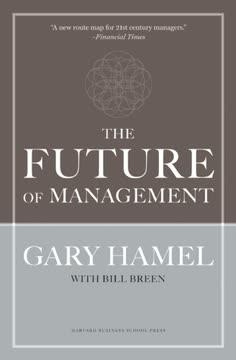
Get the complete 30-minute summary of Future of Management
Get the complete summary in the appManagement innovation is the ultimate source of long-term competitive advantage because it is nearly impossible for comp
Challenge management orthodoxies by surfacing deeply held beliefs and asking whether they are facts or assumptions.
Draw new management principles from life, markets, democracy, faith, and cities.
Study positive deviants, organizations that succeed while violating conventional management wisdom.
Build communities of purpose by combining autonomy, transparency, profit-sharing, and a mission people believe in.
Democratize innovation by giving everyone the tools, time, and permission to create.
"Future of Management" is a strong fit if you want practical ideas around business, management, leadership, especially themes like management innovation is the ultimate source of long-term competitive advantage because it is nearly impossible for comp; challenge management orthodoxies by surfacing deeply held beliefs and asking whether they are facts or assumptions. The MinuteRead summary distills these concepts into a focused read, whether you're deciding whether to buy the book or applying its lessons at work.
Gary P. Hamel is a renowned American management expert and professor of Strategic Management at London Business School. He co-founded Strategos, an international management consulting firm based in Chicago. Hamel's research focuses on strategy development in multinational contexts and management innovation. He is known for challenging traditional management practices and advocating for organizational adaptability and employee empowerment. Hamel's work has influenced many business leaders and aca…
View all summaries by Gary HamelContinue Reading
Access the complete 30-minute summary and thousands more nonfiction books in the MinuteRead app.

Continue reading the complete summary in the MinuteRead app.






