MinuteRead
30 min
Book summary
Premium summary · Opens in the app · 30 min read
Every parent carries a private museum of failures. The moments when patience snapped too quickly. The words that came out sharper than intended. The evenings spent scrolling through parenting advice while feeling utterly unequipped for the task ahead. This museum grows crowded because modern parenting has become an impossible profession, one that demands perfection while offering no training, no apprenticeship, and no clear definition of success.
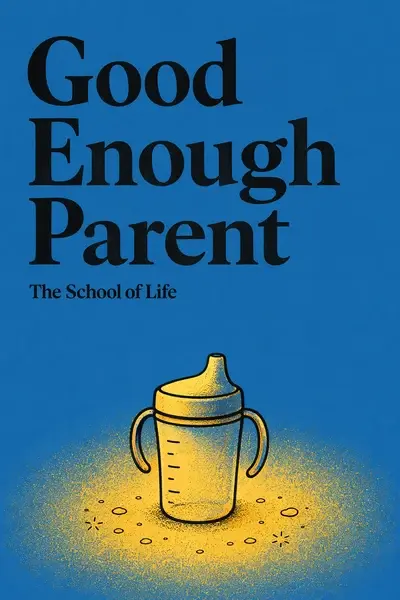
**Author:** The School of Life
**Estimated Reading Time:** 45 minutes
**What You'll Learn:** How to raise emotionally healthy children without the crushing pressure of perfection, why good parenting often looks nothing like the idealized version we imagine, and how to build a family life that honors the full range of human experience.
**Who This Book Is For:** Parents who feel exhausted by impossible standards, anyone who suspects that the modern approach to child-rearing has lost something essential, and readers who want to understand how childhood experiences shape the adults we become.
Every parent carries a private museum of failures. The moments when patience snapped too quickly. The words that came out sharper than intended. The evenings spent scrolling through parenting advice while feeling utterly unequipped for the task ahead. This museum grows crowded because modern parenting has become an impossible profession, one that demands perfection while offering no training, no apprenticeship, and no clear definition of success. The problem is not that parents lack love. Most parents love their children with an intensity that surprises even themselves. The problem is that love alone provides no instruction manual. We enter parenthood with a collection of half-remembered lessons from our own childhoods, a stream of conflicting advice from books and websites, and a deep fear of getting it wrong. The result is anxiety, exhaustion, and a nagging sense that somewhere, somehow, we are failing the people we care about most. This anxiety has a source. For generations, child-rearing wisdom passed naturally through families and communities. Grandparents lived nearby. Neighbors shared the load. Parents watched other parents and learned through observation. But modern life has fractured these networks. Many parents raise children in isolation, cut off from the accumulated wisdom that once guided the task. Into this vacuum rushed an industry of experts, each promising the correct method, the optimal approach, the scientifically proven technique. The result is not clarity but confusion. Parents now face a cacophony of competing advice, much of it contradictory, all of it demanding more than any human can deliver. The School of Life approaches this problem from a different angle. Instead of adding another voice to the chorus of experts demanding perfection, this book asks a more fundamental question: What if the goal was never perfection at all? What if the measure of good parenting is not flawless execution but consistent, loving presence? What if children need not perfect parents but good enough ones? This idea, borrowed from the pediatrician and psychoanalyst Donald Winnicott, transforms the parenting conversation. Winnicott observed that children do not require ideal conditions to thrive. They require a parent who is present, attentive, and responsive most of the time. The occasional failure, the momentary…
Continue reading in the MinuteRead app
Get the complete 30-minute summary of The Good Enough Parent
Get the complete summary in the appThe goal is not perfect parenting but good enough parenting: consistent, loving presence over time.
Accept all emotions while setting limits on behavior. Children's feelings are always valid, even when their actions are
Attunement is the core skill: read your child's emotional state and respond to the need rather than the behavior.
Repair matters as much as consistency. When you fail, apologize and try again.
Well-behaved children are not necessarily healthy children. Allow space for authentic expression, including difficult em
Protect curiosity and imagination. The question often matters more than the answer.
"The Good Enough Parent" is a strong fit if you want practical ideas around parenting, family, psychology, especially themes like the goal is not perfect parenting but good enough parenting: consistent, loving presence over time; accept all emotions while setting limits on behavior. children's feelings are always valid, even when their actions are. The MinuteRead summary distills these concepts into a focused read, whether you're deciding whether to buy the book or applying its lessons at work.
The School of Life is a global organization dedicated to helping people lead more fulfilling lives. Founded on the belief that self-knowledge is crucial for making informed decisions, particularly in love and work, the organization aims to fill the gap in education and workplace training regarding personal development. Through various mediums including films, workshops, books, and gifts, The School of Life provides tools and techniques for understanding oneself, improving relationships, careers,…
View all summaries by The School of LifeContinue Reading
Access the complete 30-minute summary and thousands more nonfiction books in the MinuteRead app.

Continue reading the complete summary in the MinuteRead app.