MinuteRead
30 min
Book summary
Premium summary · Opens in the app · 5 min read
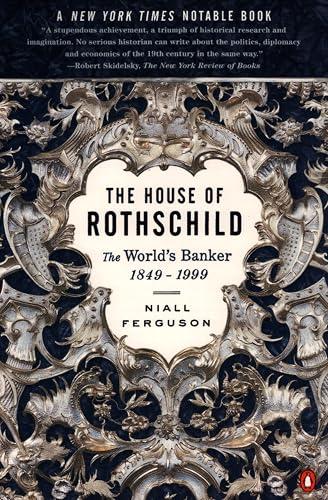
The House Of Rothschild examines the facts and myth around the wealthiest family in the world in the 19th century, and how they managed to go from being outcast and isolated to building the biggest bank in the world.
The House Of Rothschild examines the facts and myth around the wealthiest family in the world in the 19th century, and how they managed to go from being outcast and isolated to building the biggest bank in the world.
Even though you might think the name sounds aristocratic, the Rothschilds weren’t always rich. Far from it, the head of the family, Mayer Amschel Rothschild lived, like all Jews, in a ghetto in Frankfurt, Germany, with very few narrow streets, in the 1750s. The family name is simply derived from the house they inhabited, which was marked with a red shield.
It wasn’t a particularly great time for Jews, as they weren’t allowed to live outside Jews’ Lane (Judengasse), stay overnight elsewhere, use parks, inns, coffee houses or even walk along the promenade.
However, what they were allowed to do is trade. Hence, Mayer built a business buying and selling antiques. He knew how to handle money and turn a profit, so he kept leveraging smaller items into bigger, rarer ones, and thus eventually grew into Frankfurt’s leading antique dealer.
And do you know what antique dealer’s also deal with, except old chairs and lamps? Coins. Knowing a lot about currency and exchange rate, banking was a logical next step and soon Mayer extended his business to banking, scoring a few prominent clients and gaining the trust of even the Crown Prince Wilhelm of Hesse.
Instead of thinking inside his own limitations, Mayer picked an industry adjacent to the one he wanted to get into, in which he could win, and leveraged it into bigger things.
By the time Mayer died in 1812, he had set up his business and family for success. His five sons were establishing and running banks in Frankfurt, Vienna, London, Paris and Naples. Because the brothers cooperated and used their partnerships to their advantage, the five Rothschild houses in the finance hubs of Europe comprised the largest bank in the world at the time. One thing they did to stay transparent amongst each other was that each brother informed the other four of his banks’s transactions on a weekly basis. However, since in the 1800s you couldn’t just send call someone on the phone, let alone send an iMessage or email, communicating across distances was a problem. In a business that thrives on information, speed of communication is key. Moreover, since the government postal services weren’t only slow, but also nosy and kept opening letters with sensitive information, paying a premium for express delivery also stopped working at some point. Since even the best solution wasn’t good enough any longer, the Rothschilds created their own, private courier service. They picked people they knew and trusted, paid…
Continue reading in the MinuteRead app
Get the complete 5-minute summary of The House Of Rothschild
Get the complete summary in the appUse whatever industry’s available to you as leverage for the one you really want to break into.
If the best solution that’s currently available still isn’t good enough, build your own instead.
You can expect the 80/20 rule to apply in even the most extreme circumstances and businesses.
"The House Of Rothschild" is a strong fit if you want practical ideas around business, entrepreneurship, history, especially themes like use whatever industry’s available to you as leverage for the one you really want to break into; if the best solution that’s currently available still isn’t good enough, build your own instead. The MinuteRead summary distills these concepts into a focused read, whether you're deciding whether to buy the book or applying its lessons at work.
Niall Ferguson is a senior fellow at the Hoover Institution at Stanford University, former Laurence A. Tisch Professor of History at Harvard University and current senior fellow at the Center for European Studies at Harvard University, a visiting professor at Tsinghua University, Beijing, and founder and managing director of advisory firm Greenmantle LLC. The author of 15 books, Ferguson is writing a life of Henry Kissinger, the first volume of which—Kissinger, 1923-1968: The Idealist—was publis…
View all summaries by Niall FergusonContinue Reading
Access the complete 5-minute summary and thousands more nonfiction books in the MinuteRead app.

Continue reading the complete summary in the MinuteRead app.