 MinuteRead
30 min
Book summary
by Simon Sinek
Premium summary · Opens in the app · 5 min read
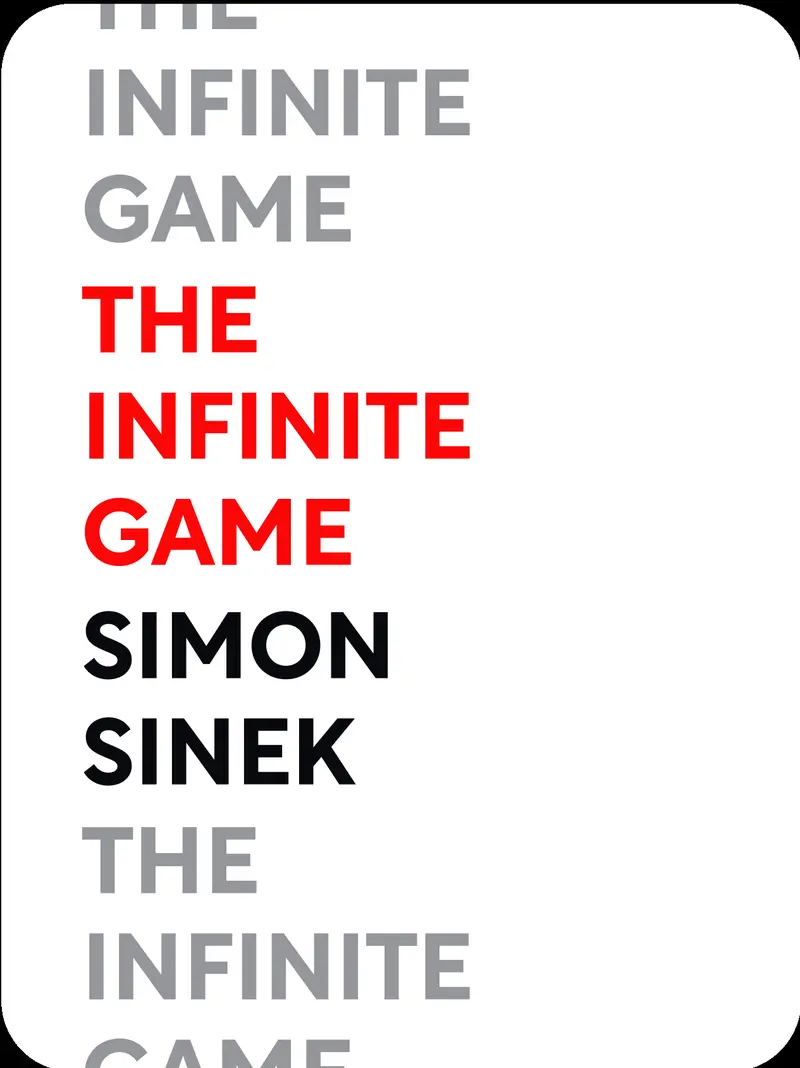
The Infinite Game argues that business is not a competition but an infinite journey, and that to do well in it, leaders must advance a “Just Cause,” build trusting teams, learn from their “Worthy Rivals,” and practice existential flexibility.
The Infinite Game argues that business is not a competition but an infinite journey, and that to do well in it, leaders must advance a “Just Cause,” build trusting teams, learn from their “Worthy Rivals,” and practice existential flexibility.
Soccer is an excellent example of a finite game. There’s a limited field on which the game is played. The rules are clear. There’s a set time for when the game begins and ends, a mechanism for keeping score, and a list of winners and losers after the fact.
Naturally, finite games inspire short-term thinking. You have to win immediately, and the only way to win is to kick your opponent out of the game. Elections, casting shows, and all sporting competitions are finite games.
Business, relationships, and education, on the other hand, are infinite games. There’s no defined beginning or end. New players join all the time. Others leave. There are rules, but they too constantly change. What the players do once they’re on the field is largely up to them, and the goal is to stay in the game rather than win.
The world is full of both finite and infinite games, and problems occur when we play infinite games with a finite mindset.
When the FIFA gave the 2022 World Cup to Qatar, for example, they did so primarily because they paid a lot of money. They also reneged on fan and player privileges, like alcohol in stadiums and the LGBT armband. Fans slammed the FIFA for its short-term thinking. They boycotted ticket sales, jerseys, and even stopped watching altogether.
Business is an infinite game. If you play it, think long-term, cooperate with others, and try to keep playing rather than win.
Sinek quotes a study that suggests S&P 500 company lifespans have declined by over 40 years, from 61 on average to 18. Why? Fewer and fewer companies try to advance a “Just Cause.” “A Just Cause is a specific vision of a future state that does not yet exist; a future state so appealing that people are willing to make sacrifices in order to help advance toward that vision,” Sinek says. It must have the following five traits: It must be for something rather than just against something. Fighting for every human’s right to eat is better than fighting against famine and starvation. It must be inclusive. We only get excited about a vision we can clearly see. It must be service-oriented. The primary beneficiary of the cause must be someone other than the business itself. It must be resilient. Will you build trains instead of cars if that’s where the world is headed? You should! It must be idealistic. Your vision should provide inspiration for…
Continue reading in the MinuteRead app
Get the complete 5-minute summary of The Infinite Game
Get the complete summary in the appThe world is full of both finite and infinite games, but business is infinite and must be played with an according mindset.
Infinite thinking requires a Just Cause, and yours must meet 5 criteria to keep you advancing with purpose.
Worthy Rivals feel like competitors, but they can actually help us learn and improve.
"The Infinite Game" is a strong fit if you want practical ideas around business, career, communication skills, especially themes like the world is full of both finite and infinite games, but business is infinite and must be played with an according mindset; infinite thinking requires a just cause, and yours must meet 5 criteria to keep you advancing with purpose. The MinuteRead summary distills these concepts into a focused read, whether you're deciding whether to buy the book or applying its lessons at work.
Simon Sinek is an optimist. He teaches leaders and organizations how to inspire people. From members of Congress to foreign ambassadors, from small businesses to corporations like Microsoft and 3M, from Hollywood to the Pentagon, he has presented his ideas about the power of why. He has written two books, Leaders Eat Last and Start With Why and is quoted frequently by national publications. Sinek also regularly shares 140 characters of inspiration on Twitter (@simonsinek).
View all summaries by Simon SinekContinue Reading
Access the complete 5-minute summary and thousands more nonfiction books in the MinuteRead app.

Continue reading the complete summary in the MinuteRead app.






