 MinuteRead
30 min
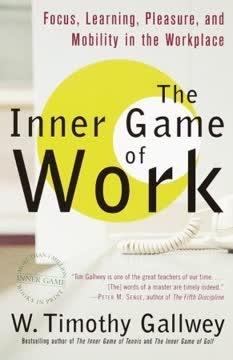
Book summary
Premium summary · Opens in the app · 30 min read
Most of us spend a significant portion of our lives working. We work to earn a living, to build careers, to contribute something meaningful, and to express who we are. Yet for many people, work is a source of stress, frustration, and quiet dissatisfaction. We feel we are capable of more than we deliver. We watch ourselves repeat the same mistakes. We struggle with focus, motivation, and the nagging sense that something is getting in the way of our best efforts.
**Author:** W. Timothy Gallwey
**Estimated Reading Time:** 45 minutes
**What You'll Learn:**
- Why your performance rarely matches your true potential - How to silence the internal voice that undermines your work - A practical method for focused attention that transforms results - How to redefine work so it becomes a source of growth and fulfillment - Tools for making conscious career decisions instead of drifting - How to coach yourself and others toward genuine mobility
**Who This Book Is For:**
Anyone who has ever felt stuck at work, frustrated by their own inconsistency, or unable to perform at the level they know they are capable of. This book is for professionals, managers, coaches, and individuals who want to understand the mental game behind sustained excellence and meaningful work.
Most of us spend a significant portion of our lives working. We work to earn a living, to build careers, to contribute something meaningful, and to express who we are. Yet for many people, work is a source of stress, frustration, and quiet dissatisfaction. We feel we are capable of more than we deliver. We watch ourselves repeat the same mistakes. We struggle with focus, motivation, and the nagging sense that something is getting in the way of our best efforts. W. Timothy Gallwey spent decades exploring this gap between what people are capable of and what they actually achieve. His journey began not in the corporate world but on the tennis court. As a coach, he noticed something curious. When he gave players detailed technical instructions, their performance often got worse. Their minds became cluttered with commands. Their bodies became stiff and hesitant. But when he asked them to simply observe the ball, to notice its spin and trajectory without judgment, something remarkable happened. Their strokes improved naturally. Their bodies seemed to know what to do once the interference of overthinking was removed. This observation led to a simple but profound equation. Performance equals potential minus interference. In other words, the problem is rarely a lack of ability. The problem is that something gets in the way of the ability we already have. Gallwey called this the Inner Game. The outer game is played against external opponents: competitors, deadlines, market conditions, difficult colleagues. The inner game is played against internal obstacles: self-doubt, fear, overanalysis, and the relentless voice of self-criticism. The outer game is visible and gets most of our attention. The inner game is invisible and determines whether we win or lose the outer game. When Gallwey first published The Inner Game of Tennis in the 1970s, he expected it to appeal to athletes. Instead, business leaders began reading it and asking him to apply the same principles to…
Continue reading in the MinuteRead app
Get the complete 30-minute summary of The Inner Game of Work
Get the complete summary in the appPerformance equals potential minus interference. Reduce interference, and performance improves naturally.
Self 1 is the critical, analytical voice. Self 2 is the natural, capable performer. Trust Self 2.
Focused attention is relaxed and curious, not forced and tense. It is the antidote to interference.
Work has three dimensions: performance, learning, and enjoyment. Attend to all three.
Mobility is conscious movement toward a goal. Conformity is unconscious drifting. Choose mobility.
Use the STOP tool before important decisions. Step back, Think, Organize, Proceed.
"The Inner Game of Work" is a strong fit if you want practical ideas around business, psychology, self help, especially themes like performance equals potential minus interference. reduce interference, and performance improves naturally; self 1 is the critical, analytical voice. self 2 is the natural, capable performer. trust self 2. The MinuteRead summary distills these concepts into a focused read, whether you're deciding whether to buy the book or applying its lessons at work.
W. Timothy Gallwey is an influential author known for developing the "Inner Game" methodology, which focuses on coaching and personal excellence across various fields. His breakthrough book, The Inner Game of Tennis, published in the 1970s, has sold over a million copies and sparked a series of related works. Gallwey's approach emphasizes mental aspects of performance and has been applied to areas such as golf, music, skiing, and work. His books aim to help individuals overcome self-imposed limi…
View all summaries by W. Timothy GallweyContinue Reading
Access the complete 30-minute summary and thousands more nonfiction books in the MinuteRead app.

Continue reading the complete summary in the MinuteRead app.






