 MinuteRead
30 min
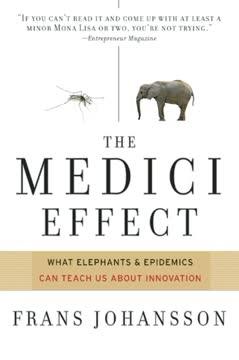
In the early fifteenth century, the city of Florence was not the most powerful city in Italy. It was not the wealthiest. It was not the largest. Yet within a single generation, Florence produced an astonishing concentration of creative genius that would shape the course of Western civilization for centuries.
**Author:** Frans Johansson
**Estimated Reading Time:** 45 minutes
**What You'll Learn:**
- Why breakthrough ideas often come from outsiders, not experts - How to break down the mental barriers that limit your creativity - Why generating many ideas matters more than finding one perfect idea - How to embrace failure as a necessary step toward innovation - Practical strategies for finding the intersections where new ideas emerge
**Who This Book Is For:**
This book is for anyone who wants to understand where breakthrough ideas come from and how to generate them consistently. Whether you are an entrepreneur, a creative professional, a scientist, a manager, or simply someone who wants to think differently, the principles in this book will change how you approach problems and opportunities.
In the early fifteenth century, the city of Florence was not the most powerful city in Italy. It was not the wealthiest. It was not the largest. Yet within a single generation, Florence produced an astonishing concentration of creative genius that would shape the course of Western civilization for centuries. Sculptors, painters, architects, poets, philosophers, financiers, and scientists all flourished in the same city at the same time. Names like Brunelleschi, Donatello, Ghiberti, and later Leonardo da Vinci and Michelangelo emerged from this relatively small city. What made Florence so special? The answer lies with a single family: the Medici. The Medici were bankers who rose to political prominence through wealth and strategic alliances. But their true legacy was not financial. They understood something profound about how creativity works. They brought together people from vastly different disciplines: painters and mathematicians, architects and poets, sculptors and engineers, merchants and philosophers. They funded artists, scientists, and thinkers from across Europe and encouraged them to interact, collaborate, and learn from one another. The result was an explosion of creativity that gave birth to the Renaissance. Sculptors learned from anatomists. Architects learned from mathematicians. Painters learned from physicists studying light. The boundaries between disciplines dissolved, and in that dissolution, entirely new ways of thinking emerged. This is the Medici Effect. Frans Johansson argues that the same principle that transformed Florence can transform how we think about innovation today. Breakthrough ideas do not come from digging deeper into a single field. They come from the intersections between fields, where different disciplines, cultures, and ways of thinking collide. The problem is that most of us are trained to avoid these intersections. We specialize. We become experts. We surround ourselves with people who think like us, work in the same field, and reinforce the same assumptions. Our education system rewards depth over breadth. Our careers reward focus over exploration. Our social networks reward conformity over diversity. Yet the evidence is overwhelming. Some…
Continue reading in the MinuteRead app
Get the complete 30-minute summary of The Medici Effect
Get the complete summary in the appBreakthrough ideas come from the Intersection, where different fields, disciplines, and cultures meet.
Associative barriers limit your ability to connect ideas from different fields. Break them down by exposing yourself to
The Intersection creates a combinatorial explosion of possible ideas. This is why diverse teams are more innovative.
The best way to find a good idea is to generate many ideas. Separate generation from evaluation.
Failure is inevitable at the Intersection. Treat failure as information, not as a verdict. Execute past failure.
Established networks resist intersectional ideas. Break out of your network and build a new one that supports your idea.
"The Medici Effect" is a strong fit if you want practical ideas around business, science, psychology, especially themes like breakthrough ideas come from the intersection, where different fields, disciplines, and cultures meet; associative barriers limit your ability to connect ideas from different fields. break them down by exposing yourself to. The MinuteRead summary distills these concepts into a focused read, whether you're deciding whether to buy the book or applying its lessons at work.
Frans Johansson is an author, entrepreneur, and speaker known for his work on innovation and creativity. Born in Sweden to a Swedish father and African American mother, Johansson grew up with diverse cultural influences. He holds a B.S. in Environmental Science from Brown University and an MBA from Harvard Business School. Johansson founded The Medici Group, a consulting firm that applies the principles from his book to help organizations innovate. He has written multiple books on creativity and…
View all summaries by Frans JohanssonContinue Reading
Access the complete 30-minute summary and thousands more nonfiction books in the MinuteRead app.

Continue reading the complete summary in the MinuteRead app.






