MinuteRead
30 min
There is a quiet crisis in leadership today. It does not show up in quarterly earnings reports or employee satisfaction surveys, at least not directly. It does not announce itself with dramatic failures or public scandals. Instead, it operates beneath the surface, slowly eroding the health of organizations and the morale of the people who work inside them.
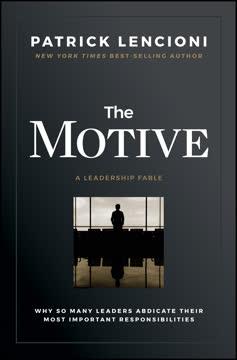
**Author:** Patrick Lencioni
**Estimated Reading Time:** 45 minutes
**What You'll Learn:** Why many leaders fail despite their experience and intelligence, how to identify the two fundamental motives that drive leadership behavior, and what it takes to become a responsibility-centered leader who builds healthy organizations.
**Who This Book Is For:** Current and aspiring CEOs, executives, managers, and anyone who wants to understand why leadership is fundamentally different from management and why the right motive matters more than skill or knowledge.
There is a quiet crisis in leadership today. It does not show up in quarterly earnings reports or employee satisfaction surveys, at least not directly. It does not announce itself with dramatic failures or public scandals. Instead, it operates beneath the surface, slowly eroding the health of organizations and the morale of the people who work inside them. The crisis is this: many people who hold leadership positions do not actually want to lead. They want the rewards of leadership, the status, the compensation, the autonomy, the recognition. But they do not want the work that leadership actually requires. Patrick Lencioni has spent decades working with CEOs and executive teams. He has observed a pattern that most leadership books miss. The problem with most struggling leaders is not a lack of knowledge. It is not a lack of intelligence, experience, or even effort. The problem is a lack of willingness to do the difficult, unglamorous, and often tedious work that leadership demands. Consider the typical path to a leadership position. A talented individual contributor performs well. They get promoted. They perform well again. They get promoted again. Eventually, they find themselves in a senior leadership role, perhaps even the CEO position. Along the way, they have been rewarded for their individual contributions, their technical expertise, their ability to solve problems and drive results. But somewhere in that journey, the nature of the work changes. The skills that earned them promotions are no longer the skills that will make them successful as leaders. And yet, many leaders continue to operate as if they were still individual contributors, gravitating toward the work they enjoy and avoiding the work they find unpleasant. This is the central insight of The Motive. Leadership is not simply a higher level of individual contribution. It is a fundamentally different kind of work, requiring a fundamentally different set of priorities and behaviors. And whether a leader embraces those priorities depends on one thing: their motive for becoming a leader in the first place. Lencioni frames this through a simple but powerful distinction. There are two motives for leadership. The first is the desire to serve others, to take responsibility for something larger than oneself, to build something that will…
Continue reading in the MinuteRead app
Get the complete 30-minute summary of The Motive
Get the complete summary in the appLeadership is a privilege, not a reward.
There are only two motives for leadership: serving others or seeking personal reward.
Your motive is revealed by what you do when faced with uncomfortable work.
Managing direct reports is a fundamental leadership responsibility.
Meetings are the arena where leadership happens.
Building a cohesive leadership team is a core CEO responsibility.
"The Motive" is a strong fit if you want practical ideas around leadership, business, management, especially themes like leadership is a privilege, not a reward; there are only two motives for leadership: serving others or seeking personal reward. The MinuteRead summary distills these concepts into a focused read, whether you're deciding whether to buy the book or applying its lessons at work.
Patrick Lencioni is a renowned author, speaker, and consultant specializing in organizational health and leadership. He founded The Table Group, a firm dedicated to improving organizations. Lencioni's books have sold millions of copies worldwide, and his ideas on leadership and teamwork have influenced organizations globally. He consults with CEOs and executive teams, helping them become more cohesive within their business strategies. Lencioni's diverse client base includes Fortune 500 companies…
View all summaries by Patrick LencioniContinue Reading
Access the complete 30-minute summary and thousands more nonfiction books in the MinuteRead app.

Continue reading the complete summary in the MinuteRead app.