MinuteRead
30 min
Book summary
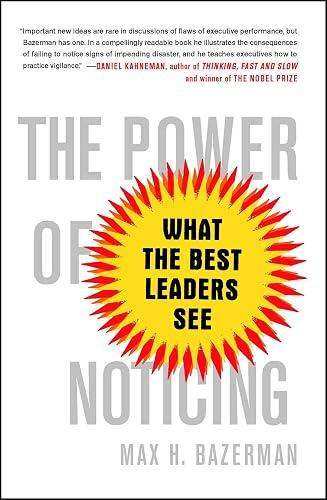
by Max H. Bazerman
Premium summary · Opens in the app · 30 min read
On January 28, 1986, the space shuttle Challenger broke apart seventy-three seconds after launch, killing all seven crew members on board. The disaster unfolded on live television, watched by millions of Americans, including schoolchildren who had tuned in to see teacher Christa McAuliffe become the first civilian in space.
**Author:** Max H. Bazerman **Estimated Reading Time:** 45 minutes
**What You'll Learn:** Why smart, experienced leaders miss critical information that is right in front of them, and how you can train yourself to see what others overlook. You will learn the psychological forces that create blindness, the systems that encourage or discourage awareness, and practical strategies for becoming a first-class noticer.
**Who This Book Is For:** Leaders who want to make better decisions, professionals who suspect they are missing important signals, and anyone who has ever wondered how intelligent people failed to prevent predictable disasters. If you want to see opportunities and threats before they become obvious, this book is for you.
On January 28, 1986, the space shuttle Challenger broke apart seventy-three seconds after launch, killing all seven crew members on board. The disaster unfolded on live television, watched by millions of Americans, including schoolchildren who had tuned in to see teacher Christa McAuliffe become the first civilian in space. What makes the Challenger tragedy so haunting is not that it was unpredictable. It was, in fact, entirely predictable. Engineers at Morton Thiokol, the contractor responsible for the shuttle's solid rocket boosters, had raised concerns about the O-ring seals in cold temperatures. The night before the launch, they recommended delaying the mission. Temperatures at the launch site had dropped below freezing, and the engineers worried the rubber O-rings would lose their flexibility and fail to seal the booster joints. Yet the launch proceeded. NASA managers, under pressure to maintain the launch schedule, dismissed the engineers' concerns. They asked for proof that the O-rings would fail, rather than proof that they would work. The engineers, unable to provide definitive evidence of failure, reluctantly withdrew their objection. The shuttle launched in temperatures far below any previous flight. The O-rings failed. Seven people died. Max Bazerman opens The Power of Noticing with this story because it illustrates a profound and uncomfortable truth: the information needed to prevent disaster was available, but the people in charge failed to notice it. They failed not because they were incompetent or malicious, but because they were human. They were subject to the same cognitive biases, organizational pressures, and motivated blindness that affect all of us. The central problem Bazerman addresses is simple to state but difficult to solve. We are all capable of missing important information, even when it is directly in front of us. We fail to notice the warning signs of impending failure. We overlook unethical behavior when it benefits us to do so. We accept conventional wisdom without questioning it. We focus on immediate outcomes while ignoring indirect consequences. This is not a book about intelligence. Many of the people who fail to…
Continue reading in the MinuteRead app
Get the complete 30-minute summary of The Power of Noticing
Get the complete summary in the appNoticing is a trainable skill, not an innate gift. First-class noticers cultivate awareness, question assumptions, and l
Cognitive biases affect everyone. Overconfidence, confirmation bias, anchoring, and availability bias systematically dis
Motivated blindness causes us to overlook unethical behavior when it benefits us. Examine your incentives honestly.
Think multiple steps ahead. Anticipate how others will respond to your actions and what the indirect effects will be.
Indirect actions and inaction can be just as harmful as direct actions. Trace causal chains to find root causes.
Question conventional wisdom. When something seems too good to be true, it probably is.
"The Power of Noticing" is a strong fit if you want practical ideas around leadership, business, psychology, especially themes like noticing is a trainable skill, not an innate gift. first-class noticers cultivate awareness, question assumptions, and l; cognitive biases affect everyone. overconfidence, confirmation bias, anchoring, and availability bias systematically dis. The MinuteRead summary distills these concepts into a focused read, whether you're deciding whether to buy the book or applying its lessons at work.
Motivated to help readers with first-class noticers are intensely attentive: they recognize talent and see opportunities that others miss, Max H. Bazerman wrote “The Power of Noticing” to package those ideas for a fast, focused read. In “The Power of Noticing”, Max H. Bazerman focuses on first-class noticers are intensely attentive: they recognize talent and see opportunities that others miss. Through “The Power of Noticing”, Max H. Bazerman distills the core ideas on leadership into lessons rea…
Continue Reading
Access the complete 30-minute summary and thousands more nonfiction books in the MinuteRead app.

Continue reading the complete summary in the MinuteRead app.