MinuteRead
30 min
Book summary
Premium summary · Opens in the app · 30 min read
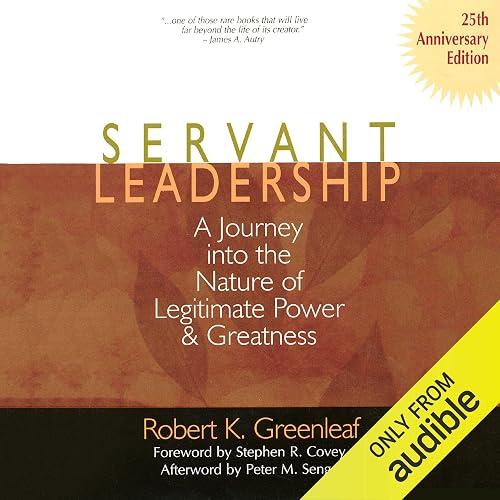
In 1970, a retired AT&T executive wrote an essay that quietly changed how the world thinks about leadership. Robert K. Greenleaf had spent four decades inside one of America's largest corporations, watching how power operated, how decisions were made, and how institutions rose and fell. What he observed troubled him. The leaders he encountered were often competent, ambitious, and intelligent. But something was missing. They led from a place of authority rather than service. They built organizati
**Author:** Robert K. Greenleaf
**Estimated Reading Time:** 48 minutes
**What You'll Learn:**
* Why the most effective leaders see themselves as servants first * How persuasion outperforms coercion in building lasting influence * What institutions must do to remain vital across generations * Why preparation for later life determines the quality of your final decades * How trustees can preserve an organization's soul while embracing change
**Who This Book Is For:**
This book is for anyone who holds authority or aspires to it. It is for executives tired of command-and-control cultures that produce compliance without commitment. It is for board members and trustees who sense that their institutions have drifted from their founding purpose. It is for young professionals wondering whether leadership requires abandoning their values. And it is for anyone who suspects that the best way to build something lasting is not to accumulate power but to give it away.
In 1970, a retired AT&T executive wrote an essay that quietly changed how the world thinks about leadership. Robert K. Greenleaf had spent four decades inside one of America's largest corporations, watching how power operated, how decisions were made, and how institutions rose and fell. What he observed troubled him. The leaders he encountered were often competent, ambitious, and intelligent. But something was missing. They led from a place of authority rather than service. They built organizations that served the few at the expense of the many. And they created cultures where people felt managed rather than inspired. Greenleaf's response was a simple but radical proposition. The best leaders, he argued, are servants first. They begin with a natural desire to help others, and only later make the conscious choice to lead. This inversion of conventional wisdom was not a soft-hearted platitude. It was a hard-nosed observation about what actually works. People follow leaders they trust. They trust leaders who care about them. And they care about leaders who serve them. The essay, titled "The Servant as Leader," spread through churches, universities, businesses, and nonprofit organizations. It resonated because it named something people had felt but could not articulate. The best bosses, the most effective administrators, the most beloved teachers all shared a quality that traditional leadership theory ignored. They saw their role as enabling others to flourish. They measured success not by what they accumulated but by what they helped others become. This book collects Greenleaf's most important essays on servant-leadership. It explores the philosophy in depth, examining its implications for individuals, institutions, and society. Greenleaf was not content to describe an ideal. He wanted to understand how servant-leadership works in practice, how it can be cultivated, and what obstacles stand in its way. He wrote about trustees…
Continue reading in the MinuteRead app
Get the complete 30-minute summary of The Power of Servant-Leadership
Get the complete summary in the app**Serve first, lead second.** The servant-leader's primary motivation is to help others, not to accumulate power.
**Measure growth, not just results.** The test of servant-leadership is whether those served become healthier, wiser, fr
**Persuade, don't coerce.** Persuasion respects the dignity of others and produces commitment that lasts.
**Listen deeply.** Set aside your own agenda and genuinely attend to what others are saying.
**Guard institutional purpose.** Trustees exist to ensure that institutions remain true to their mission.
**Lead with spirit.** Moral purpose provides the foundation for leadership that inspires.
"The Power of Servant-Leadership" is a strong fit if you want practical ideas around leadership, business, management, especially themes like **serve first, lead second.** the servant-leader's primary motivation is to help others, not to accumulate power; **measure growth, not just results.** the test of servant-leadership is whether those served become healthier, wiser, fr. The MinuteRead summary distills these concepts into a focused read, whether you're deciding whether to buy the book or applying its lessons at work.
Motivated to turn hard-won expertise into something readers can use every day, Robert K. Greenleaf wrote “The Power of Servant-Leadership” to distill the ideas behind the work into clear, actionable lessons. Through “The Power of Servant-Leadership”, Robert K. Greenleaf distills the core ideas on leadership into lessons readers can absorb in a single short sitting. Readers turn to this work when they want Robert K. Greenleaf's perspective on the subject without working through the entire origina…
View all summaries by Robert K. GreenleafContinue Reading
Access the complete 30-minute summary and thousands more nonfiction books in the MinuteRead app.

Continue reading the complete summary in the MinuteRead app.