 MinuteRead
30 min
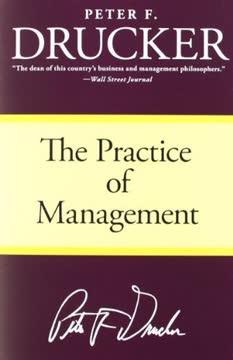
Book summary
Premium summary · Opens in the app · 30 min read
In the early 1950s, management was not yet considered a discipline. It was a collection of practices passed down through apprenticeship, a set of instincts honed by experience, a vague art practiced by those who happened to find themselves in positions of authority. Business schools taught accounting and economics, but nobody had articulated what management actually was, what it required, and how it could be learned.
**Author:** Peter F. Drucker
**Estimated Reading Time:** 45 minutes
**What You'll Learn:** - Why the sole purpose of a business is to create a customer - How management by objectives transforms organizational performance - What makes a manager truly effective - Why organizational structure must serve people, not the other way around - How to develop the managers your business will need tomorrow - The principles that separate thriving enterprises from struggling ones
**Who This Book Is For:** This book is for anyone who holds responsibility for the work of others, whether you lead a small team or an entire organization. It is for entrepreneurs building companies from the ground up, executives navigating complex enterprises, and individual contributors who aspire to lead. It is for people who sense that management is more than spreadsheets and schedules, more than authority and oversight. It is for those who want to understand the deeper logic of how organizations succeed.
In the early 1950s, management was not yet considered a discipline. It was a collection of practices passed down through apprenticeship, a set of instincts honed by experience, a vague art practiced by those who happened to find themselves in positions of authority. Business schools taught accounting and economics, but nobody had articulated what management actually was, what it required, and how it could be learned. Peter Drucker changed that. When *The Practice of Management* was published in 1954, it did something unprecedented. It treated management as a coherent body of knowledge, a practice that could be studied, understood, and improved. Drucker argued that management was not merely the exercise of power or the application of common sense. It was a discipline with its own logic, its own challenges, and its own standards of excellence. The timing was significant. The postwar economy was expanding rapidly. Large corporations were becoming the dominant institutions of society. Millions of people were entering managerial roles for the first time. They had no formal training, no established playbook, no shared vocabulary for the work they were being asked to do. Drucker gave them that vocabulary. He gave them a framework for thinking about their responsibilities. But the book's relevance extends far beyond its historical moment. The questions Drucker raised remain urgent today. What is the purpose of a business? How should managers set objectives and measure progress? What does it mean to lead people effectively? How should organizations be structured? How do we develop the leaders of tomorrow? These questions have not been resolved. They have become more complex. The rise of knowledge work, the acceleration of technological change, the globalization of markets, the shifting expectations of employees and customers, all of these developments have made the practice of…
Continue reading in the MinuteRead app
Get the complete 30-minute summary of The Practice of Management
Get the complete summary in the appThe purpose of a business is to create a customer.
Profit is a test of business validity, not the purpose of business.
Marketing and innovation are the two fundamental functions of any enterprise.
Management by objectives and self-control is a philosophy, not a set of forms.
The job of a manager is to lead people, not to supervise them.
The best structure enables maximum effort, not just clear-cut jobs.
"The Practice of Management" is a strong fit if you want practical ideas around business, management, leadership, especially themes like the purpose of a business is to create a customer; profit is a test of business validity, not the purpose of business. The MinuteRead summary distills these concepts into a focused read, whether you're deciding whether to buy the book or applying its lessons at work.
Peter Ferdinand Drucker was an influential management theorist, consultant, and professor. Born in Austria in 1909, he moved to Germany and later the United States to escape Nazi rule. Drucker authored numerous books on management and economics, popularizing concepts like "knowledge worker" and "management by objectives." He taught at New York University and Claremont Graduate University, becoming a renowned business guru. Drucker's work challenged traditional views on political economy and help…
View all summaries by Peter F. DruckerContinue Reading
Access the complete 30-minute summary and thousands more nonfiction books in the MinuteRead app.

Continue reading the complete summary in the MinuteRead app.






