MinuteRead
30 min
Book summary
Premium summary · Opens in the app · 30 min read
There is a peculiar form of self-sabotage that nearly everyone recognizes but few understand. You sit down to work on something that matters to you. Perhaps it is a report for your job, a difficult conversation you need to have, or a personal project you have been dreaming about for years. You know you should begin. You want to begin. And yet, somehow, you find yourself doing something else entirely.
**Author:** Timothy A. Pychyl
**Estimated Reading Time:** 42 minutes
**What You'll Learn:** - Why procrastination is not a time management problem but an emotional regulation problem - How your brain tricks you into believing you will feel more like working tomorrow - The single most effective strategy for breaking the procrastination cycle - How to prepare for the inevitable distractions and setbacks that derail progress - Practical frameworks for working with your personality rather than against it
**Who This Book Is For:** Anyone who has ever found themselves cleaning the kitchen at midnight instead of working on an important project. Anyone who has promised themselves they will start tomorrow, only to discover tomorrow brings the same resistance. Anyone who wants to understand why they procrastinate and, more importantly, what to do about it.
There is a peculiar form of self-sabotage that nearly everyone recognizes but few understand. You sit down to work on something that matters to you. Perhaps it is a report for your job, a difficult conversation you need to have, or a personal project you have been dreaming about for years. You know you should begin. You want to begin. And yet, somehow, you find yourself doing something else entirely. You check your email. You scroll through social media. You reorganize your desk. You decide that now is the perfect time to clean out the garage. Anything but the task at hand. This is procrastination, and it is far more complex than simple laziness or poor time management. Timothy Pychyl, a professor of psychology who has spent his career studying this phenomenon, argues that procrastination is fundamentally a problem of self-regulation. It is the voluntary delay of an intended action despite knowing that this delay will likely cause harm. The word "voluntary" matters here. Procrastination is not the same as delay. We all delay things. Life requires prioritization, and prioritization means some things must wait. But procrastination is different. It is the needless, self-defeating postponement of tasks we genuinely intend to complete. We are not choosing to delay because something more important came up. We are choosing to delay because the task itself makes us uncomfortable, and we want to escape that discomfort. This distinction explains why traditional time management advice so often fails. You can buy the perfect planner, download the latest productivity app, and create elaborate schedules. But if you do not address the underlying emotional dynamics driving your procrastination, you will simply find more sophisticated ways to avoid doing what matters. Pychyl's approach is grounded in decades of research. He does not offer motivational platitudes or quick fixes. Instead, he explains the psychological mechanisms that make procrastination so seductive and provides evidence-based strategies for…
Continue reading in the MinuteRead app
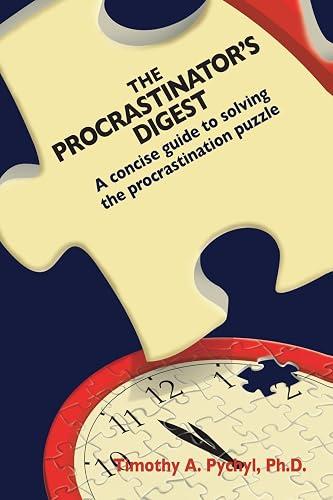
Get the complete 30-minute summary of The Procrastinator's Digest
Get the complete summary in the appProcrastination is voluntary delay that harms you. It is not the same as necessary delay.
Procrastination is driven by negative emotions. You avoid tasks because they make you feel bad.
The relief of avoidance is temporary. The costs of procrastination are lasting.
You will not feel more like doing it tomorrow. This is a predictable error in judgment.
Action precedes motivation. Start first, and the motivation will follow.
Just get started. The first small step is the most important one.
"The Procrastinator's Digest" is a strong fit if you want practical ideas around self help, psychology, mental health, especially themes like procrastination is voluntary delay that harms you. it is not the same as necessary delay; procrastination is driven by negative emotions. you avoid tasks because they make you feel bad. The MinuteRead summary distills these concepts into a focused read, whether you're deciding whether to buy the book or applying its lessons at work.
Motivated to help readers with procrastination is the voluntary delay of an intended action despite the knowledge that this delay may harm, Timothy A. Pychyl wrote “The Procrastinator's Digest” to package those ideas for a fast, focused read. In “The Procrastinator's Digest”, Timothy A. Pychyl focuses on procrastination is the voluntary delay of an intended action despite the knowledge that this delay may harm. Through “The Procrastinator's Digest”, Timothy A. Pychyl distills the core ideas on s…
View all summaries by Timothy A. PychylContinue Reading
Access the complete 30-minute summary and thousands more nonfiction books in the MinuteRead app.

Continue reading the complete summary in the MinuteRead app.