MinuteRead
30 min
Book summary
Premium summary · Opens in the app · 30 min read
Every workday, millions of people sit down at their desks, open their laptops, and begin the task of trying to do good work. Some of them will end the day feeling energized, proud, and eager for tomorrow. Others will close their computers feeling drained, frustrated, and quietly updating their resumes. The difference between these two groups is rarely about salary, job title, or company prestige. It is about something far more subtle and far more powerful: the experience of making progress in me
**Author:** Teresa Amabile **Estimated Reading Time:** 45 minutes
### What You'll Learn
Why the most powerful motivator at work is not money, recognition, or pressure, but the simple experience of making meaningful progress. You will discover how daily events shape inner work life, why setbacks hit harder than wins, and what managers can do each day to create an environment where people do their best work.
### Who This Book Is For
This book is for anyone who manages people, leads teams, or wants to understand what truly drives engagement and creativity at work. It is also for individual contributors who want to take ownership of their own motivation and performance. If you have ever wondered why some teams thrive while others languish under identical conditions, this book provides the answer.
Every workday, millions of people sit down at their desks, open their laptops, and begin the task of trying to do good work. Some of them will end the day feeling energized, proud, and eager for tomorrow. Others will close their computers feeling drained, frustrated, and quietly updating their resumes. The difference between these two groups is rarely about salary, job title, or company prestige. It is about something far more subtle and far more powerful: the experience of making progress in meaningful work. For decades, managers have been taught that motivation comes from incentives. Bonuses, promotions, stock options, and performance reviews dominate the landscape of management practice. Companies spend billions on engagement programs, culture initiatives, and leadership training. Yet the fundamental question remains: what actually makes people excited to come to work? Teresa Amabile, a psychologist and professor at Harvard Business School, spent years investigating this question with a level of rigor rarely applied to the study of everyday work life. She and her research team did not rely on surveys asking people to recall how they felt about their jobs months after the fact. Instead, they captured experience in real time. The study was ambitious. Nearly 240 professionals from seven companies across three industries participated. Each day, they completed a brief electronic diary describing their work, their emotions, their perceptions, and their motivation. They rated their feelings, described events, and reflected on what mattered. By the end, the research team had collected nearly 12,000 individual diary entries, a rich archive of inner work life as it unfolded day by day. What emerged from this data was a finding so consistent and so powerful that it reshaped how we should think about motivation. The single most important factor in driving positive inner work life was not recognition, not pay, not friendship with colleagues. It was progress. Making headway on meaningful work, even in small increments, produced the strongest…
Continue reading in the MinuteRead app
Get the complete 30-minute summary of Progress Principle
Get the complete summary in the appInner work life, the confluence of perceptions, emotions, and motivations, is the hidden driver of performance.
Progress in meaningful work is the single most powerful motivator.
Small wins have a disproportionately positive impact.
Setbacks have a disproportionately negative impact, stronger than the positive impact of progress.
Catalysts support the work; inhibitors hinder it.
Nourishers support the person; toxins harm them.
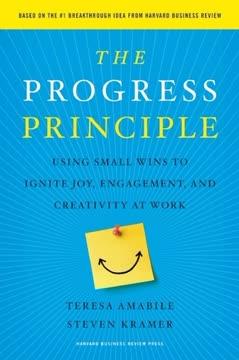
"Progress Principle" is a strong fit if you want practical ideas around business, leadership, management, especially themes like inner work life, the confluence of perceptions, emotions, and motivations, is the hidden driver of performance; progress in meaningful work is the single most powerful motivator. The MinuteRead summary distills these concepts into a focused read, whether you're deciding whether to buy the book or applying its lessons at work.
Teresa Amabile is a Baker Foundation Professor and Research Director at Harvard Business School. With a psychology doctorate from Stanford, she studies how organizational life affects people and performance. Amabile's research focuses on creativity, productivity, innovation, and inner work life. Her book "The Progress Principle" explores how daily work events impact employee engagement. She has published extensively in psychology and management journals, developed assessment tools, and presented…
View all summaries by Teresa AmabileContinue Reading
Access the complete 30-minute summary and thousands more nonfiction books in the MinuteRead app.

Continue reading the complete summary in the MinuteRead app.