MinuteRead
30 min
Book summary
Premium summary · Opens in the app · 30 min read
In 2006, a man named Ronald Read walked into a hospital in Brattleboro, Vermont. He was ninety-two years old, a retired janitor and gas station attendant. When he died, he left behind an estate worth over eight million dollars. He had no inheritance, no family wealth, no high-paying career. He simply saved what he earned and invested it in blue-chip stocks, then waited for decades.
**Author:** Morgan Housel
**Estimated Reading Time:** 45 minutes
**What You'll Learn:**
Why intelligent people make terrible financial decisions, how your personal history shapes your money beliefs, what truly drives long-term wealth, and how to build a financial life that lets you sleep at night.
**Who This Book Is For:**
Anyone who has ever felt confused by their own financial choices, frustrated by the gap between what they know they should do and what they actually do, or curious about why money behaves in ways that seem to defy logic.
In 2006, a man named Ronald Read walked into a hospital in Brattleboro, Vermont. He was ninety-two years old, a retired janitor and gas station attendant. When he died, he left behind an estate worth over eight million dollars. He had no inheritance, no family wealth, no high-paying career. He simply saved what he earned and invested it in blue-chip stocks, then waited for decades. Around the same time, a Harvard-educated finance executive named Richard Fuscone declared bankruptcy. He had been chairman of Merrill Lynch's Latin American division, earned a fortune, and spent it on a lavish lifestyle that included an eighteen-thousand-square-foot mansion with eleven bathrooms. When the financial crisis hit, his debt load crushed him. Two men. Two completely different outcomes. Neither outcome was predictable from their intelligence or education alone. This is the puzzle at the heart of money. Finance is often taught as a mathematical discipline, a field where formulas and spreadsheets determine outcomes. But real-world financial decisions are made by human beings with histories, emotions, egos, fears, and deeply held beliefs about how the world works. A person who grew up during high inflation thinks about money differently than someone who grew up during a bull market. A person who watched their parents lose everything in a recession carries different scars than someone whose family prospered. Morgan Housel wrote The Psychology of Money to explore this gap between how money should work in theory and how it actually works in practice. The book is not about investment strategies or tax optimization. It is about the soft skills of money: patience, humility, frugality, and the ability to resist the urge to compare yourself to others. These skills matter more than technical knowledge because they determine whether you can stick with a good plan long enough for it to work. The problem is that most financial advice ignores this reality. It assumes people are rational calculators who will always choose the mathematically optimal option. But humans are not spreadsheets. We are emotional creatures who make decisions based on what feels safe, what feels familiar, and what feels possible given our unique life experiences. Consider this: your personal experiences with…
Continue reading in the MinuteRead app
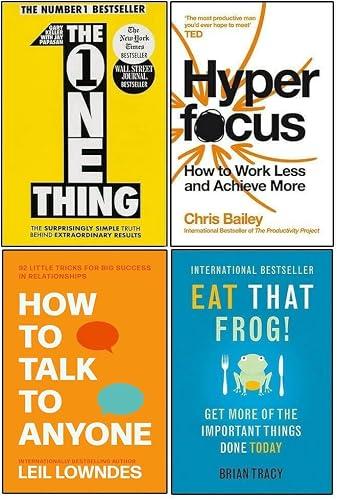
Get the complete 30-minute summary of The Psychology of Money, Hyperfocus, Eat That Frog!, How to Talk to Anyone 4 Books Collection Set
Get the complete summary in the appNo one is crazy. Financial behavior is shaped by personal experience.
Luck and risk play enormous roles in outcomes. Stay humble.
Define your "enough" or you will never feel satisfied.
Compounding is the most powerful force in finance. Start early and be patient.
Getting wealthy and staying wealthy require different skills.
A few tail events drive most results. Diversify to capture them.
"The Psychology of Money, Hyperfocus, Eat That Frog!, How to Talk to Anyone 4 Books Collection Set" is a strong fit if you want practical ideas around self help, psychology, business, especially themes like no one is crazy. financial behavior is shaped by personal experience; luck and risk play enormous roles in outcomes. stay humble. The MinuteRead summary distills these concepts into a focused read, whether you're deciding whether to buy the book or applying its lessons at work.
Motivated to help readers with your personal experiences with money make up maybe 0.00000001% of what's happened in the world, Morgan Housel wrote “The Psychology of Money, Hyperfocus, Eat That Frog!, How to Talk to Anyone 4 Books Collection Set” to package those ideas for a fast, focused read. In “The Psychology of Money, Hyperfocus, Eat That Frog!, How to Talk to Anyone 4 Books Collection Set”, Morgan Housel focuses on your personal experiences with money make up maybe 0.00000001% of what's ha…
View all summaries by Morgan HouselContinue Reading
Access the complete 30-minute summary and thousands more nonfiction books in the MinuteRead app.

Continue reading the complete summary in the MinuteRead app.