MinuteRead
5 min
Book summary
Premium summary · Opens in the app · 5 min read
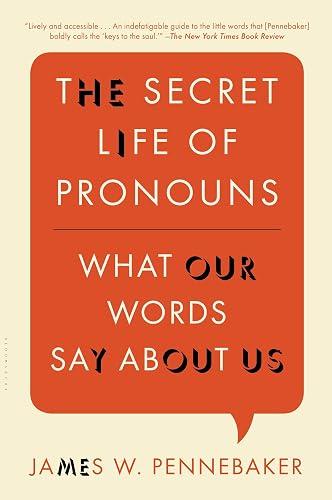
The Secret Life of Pronouns is a collection of research and case studies explaining what our use of pronouns, articles, and other style words can reveal about ourselves.
The Secret Life of Pronouns is a collection of research and case studies explaining what our use of pronouns, articles, and other style words can reveal about ourselves.
The English language and most other modern languages consist of two types of words. The first are content words – verbs, nouns, adjectives, and pronouns. These convey culturally shared meaning and denote objects, actions and abstract concepts.
Style or function words are the second type. This group includes pronouns, prepositions, articles, negations, and conjunctions. These are the words we use to organize and structure our language and make sense of the content words.
While our conscious mind usually focuses on the content words and largely ignores the function ones, it’s actually the latter that make up most of our language. They are also the ones that disclose the most information about us – for example, the degree to which we have mastered social skills.
That’s because our use of style words is linked to how we process our social context. Both structuring our speech and skills such as reading other people’s facial expressions or concealing emotions are located in the same region of the brain – the frontal lobe. Pennebaker says that this makes the two directly correlated.
Turns out, it may be possible to tell how out-going or socially awkward a person is just by looking at their use of pronouns or prepositions!
During his research, Pennebaker found that style words can reflect a lot more about people than just their social skills. In fact, it seems that the whole process of socialization each of us went through is heavily reflected in the use of pronouns. This has a lot to do with the level of self-focus any particular person exerts. As studies have shown, this may be different for men and women – and shows in the way they use language. A woman’s language is usually more loaded with “I” pronouns, suggesting that they are more conditioned for self-awareness and self-focus. Men, on average, use these singular, first-person pronouns less frequently. In turn, their speech is more loaded with articles which, according to the author, is connected to the fact that men talk about specific objects more often than women. However, gender is not the only factor influencing our use of style words. Another one is our thinking style. Pennebaker analyzed this connection by looking at stream-of-consciousness essays written by many different people during one of his experiments. His conclusions led him to identify three different thinking styles that showed through the respective use of function words. Formal thinking was characterized by frequent use of articles and prepositions. Analytic thinking, displayed by the people who strove to understand the world…
Continue reading in the MinuteRead app
Get the complete 5-minute summary of The Secret Life of Pronouns
Get the complete summary in the appYour social skills and the use of style words are located in the same region of the brain.
The pronouns you use disclose a lot about your socialization and thinking style.
People who use function words in similar ways are more likely to get on well.
"The Secret Life of Pronouns" is a strong fit if you want practical ideas around communication skills, mindfulness, psychology, especially themes like your social skills and the use of style words are located in the same region of the brain; the pronouns you use disclose a lot about your socialization and thinking style. The MinuteRead summary distills these concepts into a focused read, whether you're deciding whether to buy the book or applying its lessons at work.
James W. Pennebaker is the Regents Centennial Professor of Psychology at the University of Texas at Austin. Over the years, he and his students have studied three general topics: the psychology of physical symptoms, the power of expressive writing in helping people cope with upheavals, and, most recently, how the words people use in everyday life reveal their personality and psychological states.
View all summaries by James W. PennebakerContinue Reading
Access the complete 5-minute summary and thousands more nonfiction books in the MinuteRead app.

Continue reading the complete summary in the MinuteRead app.