MinuteRead
30 min
Every day, leaders make decisions that will determine the fate of their organizations years from now. They commit resources, hire talent, develop products, and craft strategies based on assumptions about what the future will look like. Most of them are guessing.
**Author:** Amy Webb
**Estimated Reading Time:** 45 minutes
**What You'll Learn:**
- How to distinguish genuine trends from passing fads - A systematic method for spotting emerging signals before they become obvious - How to calculate when a trend will reach critical mass - How to build scenarios that prepare you for multiple possible futures - How to pressure-test your strategies before committing resources - How to balance creative thinking with pragmatic analysis
**Who This Book Is For:**
This book is for leaders who need to make decisions today that will determine whether their organizations thrive or become obsolete tomorrow. It is for entrepreneurs searching for the next meaningful opportunity. It is for strategists tired of being surprised by change. It is for anyone who has ever wondered why some people seem to see the future while others are perpetually caught off guard. If you have ever felt that the pace of change is accelerating beyond your ability to keep up, this book offers a method for regaining control.
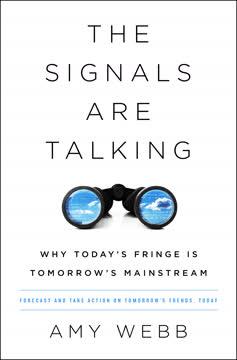
Every day, leaders make decisions that will determine the fate of their organizations years from now. They commit resources, hire talent, develop products, and craft strategies based on assumptions about what the future will look like. Most of them are guessing. The problem is not a lack of information. We are drowning in information. News feeds, research reports, market analyses, expert opinions, social media chatter. The problem is that most of this information is backward-looking. It tells us what has already happened, not what is about to happen. Traditional market research, for all its sophistication, is fundamentally a rearview mirror. It reveals the past and, at best, the present. It cannot show you the road ahead. Amy Webb encountered this problem directly. As a futurist and founder of the Future Today Institute, she spent years helping organizations ranging from Fortune 500 companies to government agencies think about what comes next. Along the way, she noticed something troubling. The people tasked with making strategic decisions were often the least equipped to understand the forces shaping their industries. They were smart, experienced, and well-intentioned. But they lacked a systematic way to think about the future. The consequences of this failure are everywhere. Companies that dominated their industries for decades have been reduced to cautionary tales. Blockbuster failed to see the streaming revolution coming. Kodak invented the digital camera but failed to understand what it meant. Nokia was the world's largest mobile phone maker until it wasn't. In each case, the signals of change were visible long before the collapse. The problem was not that the information was unavailable. The problem was that no one knew how to interpret it. Webb's insight is that…
Continue reading in the MinuteRead app
Get the complete 30-minute summary of The Signals Are Talking
Get the complete summary in the appThe future is already here, but it is unevenly distributed. Look at the fringe to see it before others do.
Use CIPHER to identify trends: Contradictions, Inflections, Practices, Hacks, Extremes, and Rarities.
A single signal is not enough. Look for convergence of multiple signals.
Ask hard questions. Challenge your assumptions. Actively seek out disconfirming evidence.
Calculate timing using the GPS ETA formula: internal developments plus or minus external events.
Create at least four scenarios: optimistic, pragmatic, pessimistic, and catastrophic.
"The Signals Are Talking" is a strong fit if you want practical ideas around business, technology, cultural, especially themes like the future is already here, but it is unevenly distributed. look at the fringe to see it before others do; use cipher to identify trends: contradictions, inflections, practices, hacks, extremes, and rarities. The MinuteRead summary distills these concepts into a focused read, whether you're deciding whether to buy the book or applying its lessons at work.
Amy Webb is a renowned futurist, author, and thinker recognized for her work in technology and future trends. She has been named one of Forbes' five women changing the world and included in the BBC's 100 Women of 2020. Webb's books, including "The Big Nine" and "The Signals Are Talking," have received numerous accolades and awards. She collaborates with Hollywood on science and technology-related projects and serves as an Emmy award judge. Webb's expertise spans various fields, including synthet…
View all summaries by Amy WebbContinue Reading
Access the complete 30-minute summary and thousands more nonfiction books in the MinuteRead app.

Continue reading the complete summary in the MinuteRead app.