 MinuteRead
30 min
Book summary
Premium summary · Opens in the app · 30 min read
Consider two people. The first is a professional athlete who earns millions of dollars playing a game he has loved since childhood. He appears on television, signs autographs, and lives in a beautiful home. The second is a janitor who cleans office buildings at night for modest pay. She works alone, her efforts largely invisible to the people who occupy those buildings during the day.
**Author:** Patrick Lencioni
**Estimated Reading Time:** 45 minutes
**What You'll Learn:**
- Why job misery has nothing to do with salary, title, or the nature of the work itself - The three hidden causes of workplace dissatisfaction and how to eliminate them - Practical strategies for managers to create environments where people genuinely love their work - How to measure what matters and help employees see their true impact - A framework that works in any industry, at any level, in any organization
**Who This Book Is For:**
Managers who want to build engaged, loyal teams. Employees who feel stuck, unseen, or unfulfilled in their work. Executives who recognize that culture is their greatest competitive advantage. And anyone who has ever wondered why a dream job turned out to be a nightmare.
Consider two people. The first is a professional athlete who earns millions of dollars playing a game he has loved since childhood. He appears on television, signs autographs, and lives in a beautiful home. The second is a janitor who cleans office buildings at night for modest pay. She works alone, her efforts largely invisible to the people who occupy those buildings during the day. Which one is happier at work? If you assumed the athlete, you might be wrong. The janitor might find deep satisfaction in knowing that her work creates a clean, healthy environment for hundreds of people. The athlete might feel anonymous despite his fame, disconnected from the people he supposedly serves, and unable to measure his own contribution beyond statistics that feel hollow. Patrick Lencioni opens his book with a simple but profound observation: a miserable job is not the same as a bad one. A bad job is one that pays poorly, offers no advancement, or involves unpleasant work. A miserable job is something else entirely. It is a job that drains the human spirit regardless of compensation, prestige, or the nature of the tasks involved. This distinction matters because it reveals something hopeful. We often assume that job satisfaction depends on factors beyond our control: the economy, the industry, the generosity of employers, the inherent appeal of the work itself. But Lencioni argues that the real drivers of job fulfillment are surprisingly simple, universally applicable, and entirely within the power of managers to address. The cost of ignoring this insight is staggering. Miserable employees are less productive, less creative, and less loyal. They spread their frustration to colleagues, customers, and family members. They arrive late, leave early, and do the minimum required. Some become destructive, undermining projects or poisoning workplace culture. The economic toll runs into billions of dollars annually, but the human toll is harder to quantify: strained marriages, neglected children,…
Continue reading in the MinuteRead app
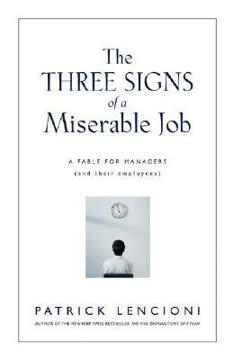
Get the complete 30-minute summary of The Three Signs of a Miserable Job
Get the complete summary in the appA miserable job is not the same as a bad one. Misery is about the experience of work, not the nature of the work.
The three signs of a miserable job are anonymity, irrelevance, and immeasurement.
Anonymity means feeling unknown as a person. Cure it by taking genuine interest in employees.
Irrelevance means feeling that your work does not matter. Cure it by helping employees see who benefits from their effor
Immeasurement means lacking ways to assess your own progress. Cure it by collaborating on meaningful metrics.
The manager is the single most important factor in employee satisfaction.
"The Three Signs of a Miserable Job" is a strong fit if you want practical ideas around business, leadership, management, especially themes like a miserable job is not the same as a bad one. misery is about the experience of work, not the nature of the work; the three signs of a miserable job are anonymity, irrelevance, and immeasurement. The MinuteRead summary distills these concepts into a focused read, whether you're deciding whether to buy the book or applying its lessons at work.
Patrick Lencioni is a bestselling author, speaker, and consultant specializing in organizational health and leadership. He founded The Table Group, a firm dedicated to improving workplace dynamics. Lencioni's books have sold millions of copies worldwide, and his ideas on teamwork and employee engagement have influenced organizations globally. He consults with CEOs and executive teams, helping them build cohesion within their business strategies. Lencioni's diverse client base includes Fortune 50…
View all summaries by Patrick LencioniContinue Reading
Access the complete 30-minute summary and thousands more nonfiction books in the MinuteRead app.

Continue reading the complete summary in the MinuteRead app.






