MinuteRead
30 min
Most financial advice operates on a hidden assumption: that the same strategies work for everyone, regardless of how much money they have. This assumption is wrong, and it causes enormous confusion.
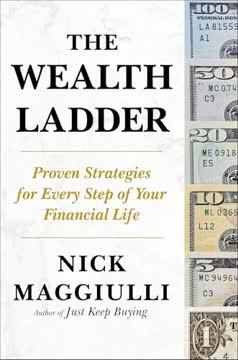
**Author:** Nick Maggiulli **Estimated Reading Time:** 45 minutes
The financial advice you have been following may be perfectly correct for someone else and completely wrong for you. This book introduces a framework that explains why. You will learn how to identify your current position on the wealth ladder, which strategies actually work at each level, and why the path to financial success requires fundamentally different approaches as your net worth grows. You will discover why spending should be tied to wealth rather than income, how leverage separates the truly wealthy from everyone else, and why money alone cannot create a meaningful life.
This book is for anyone who has ever felt confused by contradictory financial advice. It is for the person working paycheck to paycheck who wonders if budgeting is worth the effort. It is for the professional earning six figures who cannot seem to break through to the next level. It is for the entrepreneur deciding whether to keep building or sell. And it is for anyone who suspects that the pursuit of wealth, without a deeper understanding of what wealth actually provides, may be leading them in the wrong direction.
Most financial advice operates on a hidden assumption: that the same strategies work for everyone, regardless of how much money they have. This assumption is wrong, and it causes enormous confusion. Consider two pieces of advice you have probably heard. The first says that cutting expenses is the key to building wealth. Stop buying lattes, track every dollar, and watch your savings grow. The second says that focusing on small expenses is a waste of time. What matters is increasing your income, because there is only so much you can cut. Which is correct? The answer depends entirely on where you stand financially. For someone with a net worth of five thousand dollars, budgeting is essential. Every dollar matters because every dollar represents a meaningful percentage of what they have. For someone with a net worth of fifty million dollars, budgeting is nearly irrelevant. Their problem is not controlling spending. Their problem is managing complexity, risk, and the psychological weight of significant wealth. Both pieces of advice are correct. They are simply correct for different people at different stages. This book introduces a framework called the Wealth Ladder, which organizes financial progress into six distinct levels. Each level is separated by a factor of ten, from less than ten thousand dollars at the bottom to over one hundred million dollars at the top. These levels are not arbitrary. They represent genuine shifts in what your money can do for you, what strategies will work, and what challenges you will face. The framework emerged from a simple observation. When…
Continue reading in the MinuteRead app
Get the complete 30-minute summary of The Wealth Ladder
Get the complete summary in the appIdentify your current level on the Wealth Ladder and apply strategies that match your situation.
At Level 1, focus on income growth and avoiding crippling debt.
At Level 2, invest in skills with clear market value.
At Level 3, invest consistently and let compounding work.
At Level 4, seek equity in a scalable business. Earning and saving alone will not get you to Level 5.
At Level 5, diversify and protect what you have built.
"The Wealth Ladder" is a strong fit if you want practical ideas around finance, personal finance, business, especially themes like identify your current level on the wealth ladder and apply strategies that match your situation; at level 1, focus on income growth and avoiding crippling debt. The MinuteRead summary distills these concepts into a focused read, whether you're deciding whether to buy the book or applying its lessons at work.
Nick Maggiulli is a data scientist at Ritholtz Wealth Management and a popular financial blogger. His background in working-class roots informs his practical, empathetic approach to personal finance. Maggiulli's writing style, honed through years of blogging, balances analytical rigor with conversational tone. His first book, "Just Keep Buying," was a bestseller, establishing him as a trusted voice in financial literature. Maggiulli's work is known for challenging traditional financial advice an…
View all summaries by Nick MaggiulliContinue Reading
Access the complete 30-minute summary and thousands more nonfiction books in the MinuteRead app.

Continue reading the complete summary in the MinuteRead app.