MinuteRead
30 min
Book summary
Premium summary · Opens in the app · 30 min read
Financial markets are not random. They are not chaotic. They are not unpredictable.
**Author:** Rubén Villahermosa
**Estimated Reading Time:** 45 minutes
**What You'll Learn:**
- How financial markets move in predictable cycles driven by large institutional traders - The three fundamental laws that govern all market behavior - How to identify accumulation and distribution phases before major trends begin - The five phases of market structure and the key events within each phase - Practical trading strategies based on Wyckoff analysis - How to use volume to confirm or question price movements - Risk management principles that protect your capital
**Who This Book Is For:**
This book is for traders and investors who want to understand what is really happening beneath the surface of financial markets. It is for those who have tried technical indicators and found them lacking, who sense that there must be a deeper logic to market movements, and who are willing to study price action and volume with patience and discipline. Whether you trade stocks, futures, forex, or cryptocurrencies, the principles in this book apply to any market where buyers and sellers interact freely.
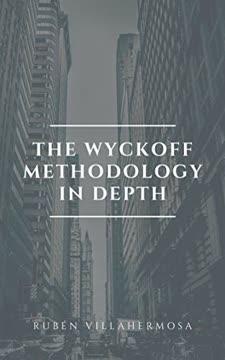
Financial markets are not random. They are not chaotic. They are not unpredictable. They are living, breathing systems driven by the continuous interaction between buyers and sellers. Every tick of price represents a transaction, and every transaction represents a decision made by someone with a view on where the market is heading. Some of those people are well-informed, well-capitalized, and highly experienced. Others are not. The Wyckoff Methodology is a framework for understanding who is doing what in the market, and why. It was developed in the early twentieth century by Richard D. Wyckoff, a stock trader and educator who spent years observing the behavior of large institutional traders and the footprints they leave in price and volume. Wyckoff realized that markets do not move randomly. They move in cycles, and those cycles are driven by the accumulation and distribution activities of the largest and most informed participants. Rubén Villahermosa has written this book to bring Wyckoff's methodology into the modern era. He explains the concepts with clarity and depth, providing traders with a complete framework for reading market structure, identifying key events, and making trading decisions based on logic rather than emotion. The problem most traders face is not a lack of information. It is a lack of context. They see a price chart covered with indicators, moving averages, and oscillators, but they do not understand what the market is actually doing. They buy when they should sell and sell when they should buy because they are reacting to surface-level signals rather than understanding the underlying structure. Wyckoff analysis solves this problem by providing a framework for understanding the market's intentions. It teaches you…
Continue reading in the MinuteRead app
Get the complete 30-minute summary of The Wyckoff Methodology in Depth
Get the complete summary in the appMarkets move in cycles of accumulation, uptrend, distribution, and downtrend, driven by large traders.
The three fundamental laws are Supply and Demand, Cause and Effect, and Effort and Result.
Accumulation is the process by which large traders build positions at low prices.
Distribution is the process by which large traders liquidate positions at high prices.
The five phases of market structure are Phase A (stopping the trend), Phase B (building the cause), Phase C (test), Phas
The spring is the key event that Wyckoff traders wait for.
"The Wyckoff Methodology in Depth" is a strong fit if you want practical ideas around money & finance, economics, personal finance, especially themes like markets move in cycles of accumulation, uptrend, distribution, and downtrend, driven by large traders; the three fundamental laws are supply and demand, cause and effect, and effort and result. The MinuteRead summary distills these concepts into a focused read, whether you're deciding whether to buy the book or applying its lessons at work.
Rubén Villahermosa is the author of "The Wyckoff Methodology in Depth," a book that delves into the intricacies of market analysis and trading. Villahermosa demonstrates a deep understanding of the Wyckoff methodology, which is evident in his comprehensive approach to explaining market structures, price cycles, and phases of accumulation and distribution. His writing style is described as direct and focused, cutting straight to the core concepts without unnecessary elaboration. While some reader…
View all summaries by Rubén VillahermosaContinue Reading
Access the complete 30-minute summary and thousands more nonfiction books in the MinuteRead app.

Continue reading the complete summary in the MinuteRead app.