 MinuteRead
30 min
Book summary
Premium summary · Opens in the app · 5 min read
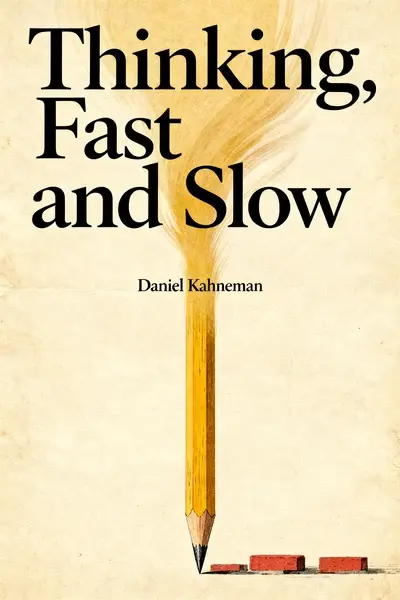
Thinking Fast and Slow shows you how two systems in your brain are constantly fighting over control of your behavior and actions, and teaches you the many ways in which this leads to errors in memory, judgment and decisions, and what you can do about it.
Thinking Fast and Slow shows you how two systems in your brain are constantly fighting over control of your behavior and actions, and teaches you the many ways in which this leads to errors in memory, judgment and decisions, and what you can do about it.
Kahneman labels the 2 systems in your mind as follows.
System 1 is automatic and impulsive.
It’s the system you use when someone sketchy enters the train and you instinctively turn towards the door and what makes you eat the entire bag of chips in front of the TV when you just wanted to have a small bowl.
System 1 is a remnant from our past, and it’s crucial to our survival. Not having to think before jumping away from a car when it honks at you is quite useful, don’t you think?
System 2 is very conscious, aware and considerate.
It helps you exert self-control and deliberately focus your attention. This system is at work when you’re meeting a friend and trying to spot them in a huge crowd of people, as it helps you recall how they look and filter out all these other people.
System 2 is one of the most ‘recent’ additions to our brain and only a few thousand years old. It’s what helps us succeed in today’s world, where our priorities have shifted from getting food and shelter to earning money, supporting a family and making many complex decisions.
However, these 2 systems don’t just perfectly alternate or work together. They often fight over who’s in charge and this conflict determines how you act and behave.
Here’s an easy trick to show you how this conflict of 2 systems affects you, it’s called the bat and ball problem. A baseball bat and a ball cost $1.10. The bat costs $1 more than the ball. How much does the ball cost? I’ll give you a second. … Got it? If your instant and initial answer is $0.10, I’m sorry to tell you that system 1 just tricked you. Do the math again. And? Once you spent a minute or two actually thinking about it, you’ll see that the ball must cost $0.05. Then, if the bat costs $1 more, it comes out to $1.05, which, combined, gives you $1.10. Fascinating, right? What happened here? When system 1 faces a tough problem it can’t solve, it’ll call system 2 into action to work out the details. But sometimes your brain perceives problems as simpler as they actually are. System 1 thinks it can handle it, even though it actually can’t, and you end up making a mistake. Why does your brain do this? Just as with habits, it wants to…
Continue reading in the MinuteRead app
Get the complete 5-minute summary of Thinking Fast and Slow
Get the complete summary in the appYour behavior is determined by 2 systems in your mind – one conscious and the other automatic.
Your brain is lazy and causes you to make intellectual errors.
When you’re making decisions about money, leave your emotions at home.
"Thinking Fast and Slow" is a strong fit if you want practical ideas around business, culture, entrepreneurship, especially themes like your behavior is determined by 2 systems in your mind – one conscious and the other automatic; your brain is lazy and causes you to make intellectual errors. The MinuteRead summary distills these concepts into a focused read, whether you're deciding whether to buy the book or applying its lessons at work.
Motivated to help readers with thinking Fast and Slow shows you how two systems in your brain are constantly fighting over control of your, Daniel Kahneman wrote “Thinking Fast and Slow” to package those ideas for a fast, focused read. In “Thinking Fast and Slow”, Daniel Kahneman focuses on thinking Fast and Slow shows you how two systems in your brain are constantly fighting over control of your. Through “Thinking Fast and Slow”, Daniel Kahneman distills the core ideas on business into lessons …
View all summaries by Daniel KahnemanContinue Reading
Access the complete 5-minute summary and thousands more nonfiction books in the MinuteRead app.

Continue reading the complete summary in the MinuteRead app.






