 MinuteRead
30 min
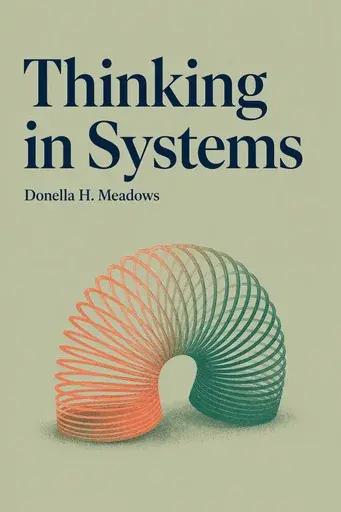
Book summary
Premium summary · Opens in the app · 30 min read
We live in a world of systems. The economy, the climate, our bodies, our communities, our organizations. These are not random collections of parts. They are interconnected wholes that behave in ways that often surprise us.
**Author:** Donella H. Meadows
**Estimated Reading Time:** 45 minutes
**What You'll Learn:**
- Why systems surprise us and how to anticipate their behavior - The hidden structures that drive growth, collapse, and stability - Where to intervene in a system for maximum impact - How to recognize the mental models that limit your thinking - Practical wisdom for navigating complexity in everyday life
**Who This Book Is For:**
Anyone who has ever wondered why well-intentioned solutions sometimes make problems worse. Managers, policymakers, students, activists, and curious minds who want to understand why the world behaves the way it does and how to work with it rather than against it.
We live in a world of systems. The economy, the climate, our bodies, our communities, our organizations. These are not random collections of parts. They are interconnected wholes that behave in ways that often surprise us. Consider a simple question: Why do traffic jams form even when there is no accident? Why does a new highway sometimes make congestion worse instead of better? Why do some businesses grow explosively and then collapse? Why do well-intentioned aid programs sometimes leave communities worse off than before? The answer, Donella Meadows argues, is that we are surrounded by systems, but we are not taught to see them. We are taught to break problems into pieces, to analyze parts in isolation, to look for simple cause-and-effect chains. This approach works well for simple problems. It fails badly for complex ones. Meadows was one of the pioneers of systems thinking. Trained as a biophysicist at Harvard and later a research fellow at MIT working with Jay Forrester, the inventor of system dynamics, she spent her career understanding how systems behave and why they so often defy our expectations. She was the lead author of the groundbreaking 1972 book *The Limits to Growth*, which used computer models to explore the long-term consequences of population growth, resource depletion, and pollution. That work made her one of the most influential environmental scientists of the twentieth century. But *Thinking in Systems* is not a book about computer models or environmental policy. It is a book about how to see. It is a primer on a different way of understanding the world, one that focuses on relationships rather than things, on patterns rather than events, on wholes rather than parts. The problem Meadows addresses is both simple and profound: our mental models are too simple for the world we live in. We see events and miss the structures that produce them. We see linear chains of cause and effect and miss the circular feedback loops that actually drive behavior. We see stocks of things and miss the flows that change them.…
Continue reading in the MinuteRead app
Get the complete 30-minute summary of Thinking In Systems
Get the complete summary in the app**A system is an interconnected set of elements organized to achieve a purpose.** The behavior emerges from the structur
**Stocks are accumulations. Flows are rates of change.** You cannot change a stock directly. You can only change the flo
**Feedback loops drive system behavior.** Reinforcing loops amplify change. Balancing loops counteract change.
**Delays cause oscillation.** The longer the delay, the more likely you are to overreact.
**Leverage points are counterintuitive.** The most obvious interventions are often the least effective. The most powerfu
**Everything you know is a model.** Hold your models lightly. Treat them as hypotheses, not truths.
"Thinking In Systems" is a strong fit if you want practical ideas around business, science, psychology, especially themes like **a system is an interconnected set of elements organized to achieve a purpose.** the behavior emerges from the structur; **stocks are accumulations. flows are rates of change.** you cannot change a stock directly. you can only change the flo. The MinuteRead summary distills these concepts into a focused read, whether you're deciding whether to buy the book or applying its lessons at work.
Donella H. "Dana" Meadows was a prominent American environmental scientist, teacher, and writer. She earned a B.A. in chemistry from Carleton College and a Ph.D. in biophysics from Harvard. Meadows became a research fellow at MIT, working with Jay Forrester, the inventor of system dynamics. She taught at Dartmouth College for 29 years, starting in 1972. Meadows was a pioneering figure in environmental science and systems thinking, known for her work on sustainability and global modeling. Her int…
View all summaries by Donella H. MeadowsContinue Reading
Access the complete 30-minute summary and thousands more nonfiction books in the MinuteRead app.

Continue reading the complete summary in the MinuteRead app.






