 MinuteRead
30 min
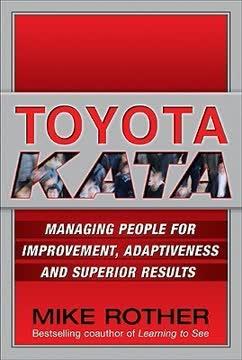
Book summary
by Mike Rother
Premium summary · Opens in the app · 30 min read
Every organization wants to improve. Every leader wants their team to solve problems more effectively. Every company wants to adapt to changing conditions with speed and confidence. Yet most organizations struggle to achieve these outcomes despite investing enormous resources in improvement programs, training initiatives, and management systems.
**Author:** Mike Rother
**Estimated Reading Time:** 45 minutes
**What You'll Learn:**
- Why Toyota's competitive advantage is not its tools, but its routines for thinking and acting - How to use the Improvement Kata to navigate toward challenging goals through systematic experimentation - How the Coaching Kata develops problem-solving capability in people at every level - Why traditional management approaches fail to create continuous improvement - How to begin practicing these routines in your own organization
**Who This Book Is For:**
This book is for leaders, managers, and practitioners who want to move beyond implementing lean tools and start building an organization that continuously improves and adapts. It is for anyone who has wondered why some organizations seem to get smarter over time while others remain stuck in firefighting mode. If you are responsible for developing people, improving processes, or leading organizational change, this book provides a practical framework you can begin using immediately.
Every organization wants to improve. Every leader wants their team to solve problems more effectively. Every company wants to adapt to changing conditions with speed and confidence. Yet most organizations struggle to achieve these outcomes despite investing enormous resources in improvement programs, training initiatives, and management systems. The question is why. Mike Rother spent over six years studying Toyota's management practices, trying to understand what makes the company different. He did not find what most people expect. Toyota's advantage is not a collection of tools like kanban, andon cords, or 5S. Those tools are visible, but they are not the source of Toyota's strength. The tools are outcomes of something deeper, something harder to see. What Rother discovered is that Toyota's real advantage lies in its routines. Specifically, Toyota has developed and institutionalized two routines that work together: a routine for improvement and a routine for teaching that improvement routine to others. These routines are called kata, a Japanese word that refers to patterns of behavior that are practiced until they become automatic. Think about how a martial artist trains. They do not simply learn techniques intellectually. They practice movements thousands of times until the movements become part of them, until they can execute without thinking. The same principle applies to organizations. Toyota has developed behavioral patterns that its people practice daily, and these patterns enable the company to navigate uncertainty in ways that competitors cannot match. The central problem this book addresses is that most organizations approach improvement as a series of projects or initiatives. They identify a problem, implement a solution, and move on. This approach works for known problems with known solutions. But the most important challenges organizations face are not like that. They involve uncertainty. The path forward is unclear. What works…
Continue reading in the MinuteRead app
Get the complete 30-minute summary of Toyota Kata
Get the complete summary in the appToyota's advantage is its routines for improvement and coaching, not its tools.
The Improvement Kata has four steps: direction, current condition, target condition, and PDCA cycles.
A target condition is a specific, measurable future state achievable within one to three months.
PDCA cycles are rapid experiments. Each cycle should take hours or days.
The Coaching Kata uses five questions to develop problem-solving capability.
Leaders are teachers. Their primary job is developing people, not solving problems.
"Toyota Kata" is a strong fit if you want practical ideas around business, management, leadership, especially themes like toyota's advantage is its routines for improvement and coaching, not its tools; the improvement kata has four steps: direction, current condition, target condition, and pdca cycles. The MinuteRead summary distills these concepts into a focused read, whether you're deciding whether to buy the book or applying its lessons at work.
Mike Rother is an engineer, researcher, and teacher known for his work on lean manufacturing and continuous improvement. He spent over six years studying Toyota's management practices, which led to the development of the Toyota Kata concept. Rother has authored several influential books on lean management and organizational improvement. His work focuses on practical approaches to creating adaptive, continuously improving organizations. Mike Rother is recognized for bridging the gap between acade…
View all summaries by Mike RotherContinue Reading
Access the complete 30-minute summary and thousands more nonfiction books in the MinuteRead app.

Continue reading the complete summary in the MinuteRead app.






