 MinuteRead
30 min
Book summary
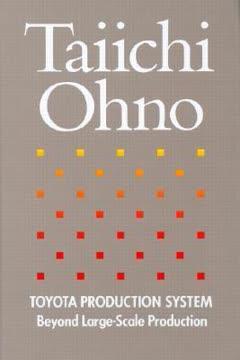
by Taiichi Ohno
Premium summary · Opens in the app · 30 min read
In the years following World War II, Japan faced a brutal economic reality. The country's industrial base lay in ruins. Capital was scarce. Domestic markets were small and fragmented. Raw materials had to be imported at great expense. And yet, within a few decades, Japanese manufacturing would emerge as a global force, with Toyota at the forefront.
**Author:** Taiichi Ohno **Estimated Reading Time:** 45 minutes
The core principles behind the most influential manufacturing system ever created, how just-in-time production and autonomation work together to eliminate waste, why visual management tools like kanban transform coordination, and how the relentless pursuit of improvement creates lasting competitive advantage.
This book is for managers, engineers, entrepreneurs, and anyone responsible for improving how work gets done. It is for people who sense that their organization carries too much inventory, too many defects, too much wasted motion, and too little clarity. It is also for readers curious about how a small Japanese automaker with limited resources built a system that would eventually reshape manufacturing across the world.
In the years following World War II, Japan faced a brutal economic reality. The country's industrial base lay in ruins. Capital was scarce. Domestic markets were small and fragmented. Raw materials had to be imported at great expense. And yet, within a few decades, Japanese manufacturing would emerge as a global force, with Toyota at the forefront. Taiichi Ohno, the architect of the Toyota Production System, understood something that many industrial leaders of his era did not. The American model of mass production, pioneered by Henry Ford and refined by General Motors, was extraordinarily efficient at producing enormous quantities of identical products. But that model depended on conditions that Japan simply did not have. It required vast domestic markets, abundant capital, cheap raw materials, and the ability to produce in massive batches without regard for variety. Japan's market was different. A Japanese automaker in the 1950s could not sell a million identical sedans. The market demanded small volumes of many different vehicles. Capital was too expensive to tie up in mountains of inventory. Space was too limited to store weeks of work in progress. The American system, for all its brilliance, would not work in Toyota's context. Ohno's insight was to stop asking how Japan could copy American methods and instead ask what the ideal production system would look like if it were designed from first principles. What if you could produce exactly what the customer wanted, exactly when they wanted it, in exactly the right quantity, with zero waste? What if every worker, every machine, every process was perfectly coordinated to flow without interruption? The answer to those questions became the Toyota Production System. The system rests on two pillars. The first is just-in-time: the practice of producing and delivering the right parts at the right time in the right amounts. The second is autonomation, sometimes called "automation with a human touch": the practice of building quality into the process by giving machines and workers the ability to detect abnormalities and stop production immediately. These…
Continue reading in the MinuteRead app
Get the complete 30-minute summary of Toyota Production System
Get the complete summary in the appJust-in-time means producing the right items at the right time in the right quantity. The downstream process pulls from
Overproduction is the root waste. It creates all other wastes. Eliminate overproduction first.
Autonomation means building quality into the process. Machines stop when something goes wrong. Workers stop the line whe
The seven wastes are overproduction, waiting, transportation, over-processing, inventory, motion, and defects. Learn to
Kanban is a visual signal that authorizes production. Nothing is produced without a kanban. Reducing kanban exposes prob
Production leveling is the foundation of just-in-time. Balance production by volume and mix. Reduce setup times to make
"Toyota Production System" is a strong fit if you want practical ideas around business, management, leadership, especially themes like just-in-time means producing the right items at the right time in the right quantity. the downstream process pulls from; overproduction is the root waste. it creates all other wastes. eliminate overproduction first. The MinuteRead summary distills these concepts into a focused read, whether you're deciding whether to buy the book or applying its lessons at work.
Taiichi Ohno was a Japanese industrial engineer and businessman widely considered the father of the Toyota Production System. Born in 1912, Taiichi Ohno joined Toyota Motor Corporation in 1943 and played a crucial role in developing the company's innovative manufacturing processes. His work focused on eliminating waste, improving efficiency, and implementing just-in-time production methods. Ohno's ideas revolutionized manufacturing and influenced management practices worldwide, extending beyond …
View all summaries by Taiichi OhnoContinue Reading
Access the complete 30-minute summary and thousands more nonfiction books in the MinuteRead app.

Continue reading the complete summary in the MinuteRead app.






