MinuteRead
30 min
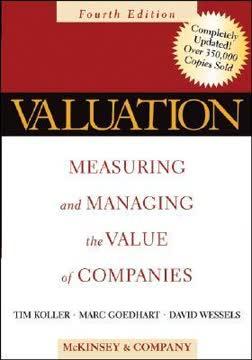
Every business decision ultimately comes down to one question: does this create value? Yet for all the sophistication of modern finance, remarkably few people can answer that question with clarity and confidence. Managers pursue growth for its own sake. Investors chase stories instead of fundamentals. Boards approve acquisitions that destroy billions in shareholder wealth. The gap between knowing that value matters and understanding how to measure it remains vast.
**Author:** McKinsey & Company Inc.
**Estimated Reading Time:** 45 minutes
**What You'll Learn:** How to measure and create value in a market economy, the fundamental drivers of corporate value, the mechanics of discounted cash flow and economic profit models, how to forecast performance accurately, and how to apply valuation principles to make better strategic and investment decisions.
**Who This Book Is For:** Executives making capital allocation decisions, investors evaluating opportunities, analysts building valuation models, students of corporate finance, and anyone who wants to understand what truly drives the value of a business.
Every business decision ultimately comes down to one question: does this create value? Yet for all the sophistication of modern finance, remarkably few people can answer that question with clarity and confidence. Managers pursue growth for its own sake. Investors chase stories instead of fundamentals. Boards approve acquisitions that destroy billions in shareholder wealth. The gap between knowing that value matters and understanding how to measure it remains vast. This book exists to close that gap. The problem is not a lack of information. Companies produce endless streams of financial data. Analysts build elaborate models. Consultants present complex frameworks. But information without a coherent mental model is just noise. What executives and investors need is a way to cut through the complexity and see the fundamental economics of a business clearly. They need to understand what drives value, how to measure it, and how to use that understanding to make better decisions. The stakes could hardly be higher. Capital misallocation destroys wealth on a staggering scale. Companies overpay for acquisitions because they do not understand what they are buying. Managers underinvest in valuable opportunities because they cannot demonstrate their worth. Investors overpay for glamorous growth stories while ignoring unglamorous value creators. In a market economy, the ability to value assets accurately is not a technical skill reserved for specialists. It is the foundation of sound decision-making at every level. McKinsey's approach to valuation is distinctive because it is grounded in a simple but powerful insight: value is created only when a company generates returns on its invested capital that exceed its cost of capital. Everything else is commentary. Growth creates value only when it comes with attractive returns. Acquisitions create value only when the price paid is less than the value received. Strategy creates value only when it leads to sustainable competitive advantages that translate into superior financial performance. This insight seems obvious when stated plainly. Yet it is routinely ignored in practice. Companies celebrate revenue growth while destroying value. Investors bid up stocks based on narratives rather than cash flows. Managers make decisions based on accounting earnings that bear little relationship to economic reality. The gap between…
Continue reading in the MinuteRead app
Get the complete 30-minute summary of Valuation
Get the complete summary in the app**Value is created only when ROIC exceeds WACC.** The spread between return on invested capital and cost of capital is t
**Growth creates value only at returns above the cost of capital.** Growth without returns destroys value. Fix returns f
**Free cash flow is the ultimate source of value.** A company's value is the present value of its future free cash flows
**Economic profit measures value creation directly.** It equals invested capital multiplied by the spread between ROIC a
**The cost of capital is the opportunity cost of investing in a particular business.** It is the minimum return required
**Continuing value often accounts for the majority of total value.** Get the long-term assumptions right.
"Valuation" is a strong fit if you want practical ideas around finance, business, economics, especially themes like **value is created only when roic exceeds wacc.** the spread between return on invested capital and cost of capital is t; **growth creates value only at returns above the cost of capital.** growth without returns destroys value. fix returns f. The MinuteRead summary distills these concepts into a focused read, whether you're deciding whether to buy the book or applying its lessons at work.
McKinsey & Company Inc. is a renowned global management consulting firm founded in 1926. McKinsey & Company Inc. is known for its influential research and publications in business strategy, organizational structure, and financial management. The firm's consultants work with leading corporations, governments, and non-profit organizations worldwide. McKinsey's expertise in valuation and corporate finance is reflected in their authorship of "Valuation," which has become a standard text in the field…
View all summaries by McKinseyContinue Reading
Access the complete 30-minute summary and thousands more nonfiction books in the MinuteRead app.

Continue reading the complete summary in the MinuteRead app.