MinuteRead
30 min
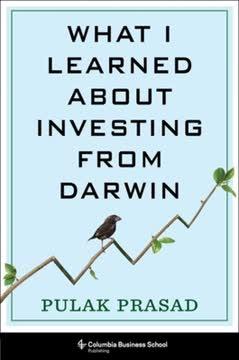
Book summary
by Pulak Prasad
Premium summary · Opens in the app · 30 min read
The investment world is drowning in noise. Every day brings a flood of earnings reports, analyst upgrades, macroeconomic forecasts, and breathless commentary about market movements. The implicit message is always the same: something important is happening right now, and you must act. The industry profits from this urgency. Trading generates commissions. Complexity justifies fees. Activity creates the illusion of expertise.
**Author:** Pulak Prasad
**Estimated Reading Time:** 45 minutes
**What You'll Learn:**
- Why avoiding big risks matters more than chasing big returns - How evolutionary biology reveals the secrets of durable business quality - What honest and dishonest signals from companies look like - Why patience is the most underrated investing skill - How to build a simple, repeatable investment process that survives market chaos
**Who This Book Is For:**
This book is for investors who are tired of complexity. It is for people who have watched their portfolios suffer from impulsive decisions, who have been burned by turnaround stories, and who suspect that the financial industry profits from making simple things complicated. It is also for anyone curious about how the principles of natural selection can illuminate the behavior of businesses and markets. If you want a framework that emphasizes survival, quality, and patience over prediction, this book will change how you think about investing.
The investment world is drowning in noise. Every day brings a flood of earnings reports, analyst upgrades, macroeconomic forecasts, and breathless commentary about market movements. The implicit message is always the same: something important is happening right now, and you must act. The industry profits from this urgency. Trading generates commissions. Complexity justifies fees. Activity creates the illusion of expertise. Pulak Prasad looked at this world and asked a different question. What if the best investment approach was not about doing more, but about doing less? What if the key to long-term success was not predicting the future, but understanding the deep patterns of the past? Prasad is not a typical fund manager. He founded Nalanda Capital in 2007 and built it into a fund managing over five billion dollars focused on listed Indian companies. His track record is exceptional. Since inception, the fund has delivered a compound annual growth rate of around twenty percent, significantly outperforming the market. Yet Prasad remains reclusive, avoiding media appearances and industry conferences. His focus is not on marketing but on thinking. What makes Prasad's thinking distinctive is his intellectual foundation. Before becoming an investor, he was a consultant at McKinsey. But his true intellectual hero is not a business guru or a famous investor. It is Charles Darwin. Darwin's theory of evolution by natural selection is one of the most powerful explanatory frameworks ever developed. It explains how organisms adapt to their environments over millions of years. It explains why some species survive while others go extinct. It explains the logic of biological systems without requiring a designer or a plan. Prasad realized that the same principles apply to business. Companies compete in markets the way organisms compete in ecosystems. Some businesses have durable advantages that allow…
Continue reading in the MinuteRead app
Get the complete 30-minute summary of What I Learned About Investing from Darwin
Get the complete summary in the appAvoid big risks. The most important rule in investing is to not lose money.
Buy high-quality businesses with durable competitive advantages, high returns on capital, and good management.
Use history as your guide. Long track records are more reliable than future projections.
Focus on honest signals that are costly to produce. Ignore cheap talk.
Embrace business stasis. Great businesses generally stay great.
Prepare for punctuation events. Rare disruptions create opportunity for those who are ready.
"What I Learned About Investing from Darwin" is a strong fit if you want practical ideas around finance, business, economics, especially themes like avoid big risks. the most important rule in investing is to not lose money; buy high-quality businesses with durable competitive advantages, high returns on capital, and good management. The MinuteRead summary distills these concepts into a focused read, whether you're deciding whether to buy the book or applying its lessons at work.
Pulak Prasad is the founder and CEO of Nalanda Capital, a $5 billion fund focused on investing in listed Indian companies. Pulak Prasad has maintained a low profile despite his success, with his fund outperforming the market with a 20% CAGR since its inception in 2007. A McKinsey alumnus, Prasad's investment philosophy emphasizes avoiding big risks, buying quality at the right price, and being patient. His approach involves investing in low-beta stocks with robust business models, high Return on…
View all summaries by Pulak PrasadContinue Reading
Access the complete 30-minute summary and thousands more nonfiction books in the MinuteRead app.

Continue reading the complete summary in the MinuteRead app.