 MinuteRead
30 min
Book summary
Premium summary · Opens in the app · 30 min read
Imagine sitting in a meeting room in Tokyo. Your Japanese counterparts are listening attentively, nodding occasionally, and saying very little. You present your proposal clearly, answer questions directly, and leave feeling confident. Weeks later, you discover the deal has stalled. No one said no. No one raised objections. But nothing moved forward either.
**Author:** Richard D. Lewis
**Estimated Reading Time:** 45 minutes
**What You'll Learn:** How cultural conditioning shapes every aspect of human interaction, why the world divides into three broad cultural categories, and how to communicate, negotiate, lead, and build trust across cultural boundaries.
**Who This Book Is For:** Anyone who works across borders, manages international teams, negotiates with foreign partners, or simply wants to understand why people from different backgrounds think and behave so differently.
Imagine sitting in a meeting room in Tokyo. Your Japanese counterparts are listening attentively, nodding occasionally, and saying very little. You present your proposal clearly, answer questions directly, and leave feeling confident. Weeks later, you discover the deal has stalled. No one said no. No one raised objections. But nothing moved forward either. Now imagine a different scenario. You are in Milan, negotiating with an Italian firm. The meeting starts late, several people talk at once, and your carefully prepared agenda falls apart within minutes. Yet somehow, by the end of a long lunch, you have the outlines of an agreement. The process felt chaotic, but the outcome was positive. Neither of these experiences makes sense through a purely rational, business-focused lens. Something else is at work. That something is culture. Richard D. Lewis wrote *When Cultures Collide* to address a fundamental problem: human beings are culturally programmed from birth, and most of us remain largely unaware of our own programming. We assume our way of seeing the world is natural, universal, and correct. When we encounter people who think differently, we tend to view them as difficult, irrational, or even wrong. This assumption causes endless friction in international business, diplomacy, and personal relationships. The problem is not going away. Globalization has brought people from different cultural backgrounds into closer contact than ever before. Yet proximity does not automatically produce understanding. In many cases, it produces more frequent and more costly misunderstandings. A manager in London may now lead a team spanning five continents. A salesperson in Chicago may negotiate daily with buyers in Shanghai, São Paulo, and Riyadh. The opportunities are enormous, but so are the risks of getting it wrong. Lewis argues that most cross-cultural training fails because it focuses on surface-level etiquette: how to exchange business cards, when to bow, what gifts to give. These details matter, but they are only the visible tip of a much deeper iceberg. Beneath the surface lie fundamental differences in how people perceive time, structure relationships, make decisions, express emotions, and define success. Without understanding these deeper patterns, surface-level knowledge is fragile and easily overwhelmed by real-world complexity. What makes Lewis's approach distinctive is his insistence that culture is not a vague, mystical force. It is observable,…
Continue reading in the MinuteRead app
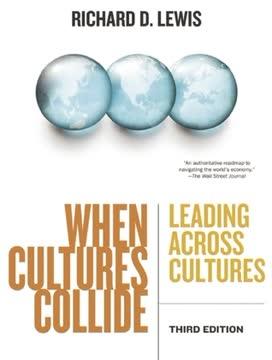
Get the complete 30-minute summary of When Cultures Collide
Get the complete summary in the appCultural conditioning shapes everything, and most of us are unaware of our own programming.
The world divides into three cultural types: linear-active, multi-active, and reactive.
Time perception varies across cultures: linear versus cyclic.
Communication styles vary from low-context to high-context.
Leadership expectations differ dramatically across cultures.
Negotiation strategies must be adapted to the cultural context.
"When Cultures Collide" is a strong fit if you want practical ideas around business, cultural, leadership, especially themes like cultural conditioning shapes everything, and most of us are unaware of our own programming; the world divides into three cultural types: linear-active, multi-active, and reactive. The MinuteRead summary distills these concepts into a focused read, whether you're deciding whether to buy the book or applying its lessons at work.
Richard Donald Lewis is a renowned British linguist and author specializing in cross-cultural communication. Born in 1930, he founded Berlitz schools in East Asia, Portugal, and Finland. Lewis has authored several books, with "When Cultures Collide" being his most successful, selling over 500,000 copies and winning awards. He has lectured worldwide on cross-cultural issues and served as a personal tutor to members of the Japanese Imperial family. In recognition of his contributions to Finland's …
View all summaries by Richard D. LewisContinue Reading
Access the complete 30-minute summary and thousands more nonfiction books in the MinuteRead app.

Continue reading the complete summary in the MinuteRead app.






