 MinuteRead
30 min
Book summary
Premium summary · Opens in the app · 30 min read
To those convinced that a secretive cabal controls the world, the usual suspects are the Illuminati, Lizard People, or globalists. They are wrong, naturally. There is no secret society shaping every major decision and determining the direction of human history.
**Author:** Walt Bogdanich
**Estimated Reading Time:** 45 minutes
**What You'll Learn:** How the world's most powerful consulting firm shapes governments, corporations, and society while operating with extraordinary secrecy. You will understand McKinsey's role in widening inequality, fueling the opioid crisis, enabling authoritarian regimes, and contributing to financial instability. You will see how the firm's relentless pursuit of profit has created lasting consequences for public health, democracy, and the environment.
**Who This Book Is For:** Anyone who wants to understand the hidden forces shaping modern capitalism, citizens concerned about corporate influence on democracy, professionals navigating ethical dilemmas in their careers, and readers who suspect that powerful institutions operate beyond public accountability.
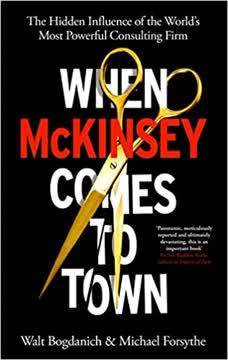
To those convinced that a secretive cabal controls the world, the usual suspects are the Illuminati, Lizard People, or globalists. They are wrong, naturally. There is no secret society shaping every major decision and determining the direction of human history. There is, however, McKinsey and Company. The firm does not announce its influence. It does not seek public attention. It operates with a level of discretion that would impress an intelligence agency. Yet McKinsey's fingerprints appear on nearly every major economic and political development of the past century. The firm has advised ninety percent of the world's hundred largest corporations. It has consulted for governments in more than one hundred thirty countries. Its alumni occupy corner offices, cabinet positions, and central bank governorships across the globe. When McKinsey Comes to Town reveals what happens when the world's most prestigious consulting firm applies its analytical rigor to the world's most consequential problems. The answer is not reassuring. Walt Bogdanich, a three-time Pulitzer Prize winning investigative journalist, spent years examining McKinsey's internal documents, interviewing former consultants, and tracing the outcomes of the firm's most significant engagements. What emerges is a portrait of an institution that has systematically prioritized profit over principle, secrecy over accountability, and client interests over public welfare. The problem McKinsey addresses is straightforward. Large organizations face complex challenges. They need smart people to analyze data, design strategies, and implement changes. McKinsey provides exactly this service, staffing engagements with graduates from the world's most elite universities and applying proprietary frameworks to seemingly intractable problems. The problem McKinsey creates is less obvious but far more consequential. When the firm's brilliant analysts apply their frameworks to selling more opioids, they succeed. When they help authoritarian regimes tighten their grip on power, they succeed. When they advise insurance companies on how to systematically deny claims, they succeed. When they help fossil fuel companies expand production while publicly advocating for climate action, they succeed. The book exists because these successes have human costs. The opioid crisis has killed hundreds of thousands of Americans. Authoritarian…
Continue reading in the MinuteRead app
Get the complete 30-minute summary of When McKinsey Comes to Town
Get the complete summary in the appMcKinsey is not a neutral advisor. It is a profit-maximizing enterprise whose business model systematically produces har
Secrecy is the mechanism that enables all of McKinsey's other problematic practices. Without it, the firm could not main
McKinsey played a direct role in fueling the opioid crisis by advising Purdue Pharma on strategies to boost OxyContin sa
The firm's advice has consistently pushed corporations to prioritize shareholder value over workers, customers, and comm
McKinsey has built extensive relationships with authoritarian regimes, providing legitimacy and operational effectivenes
The firm's environmental reputation is a marketing artifact. McKinsey continues to advise fossil fuel companies on expan
"When McKinsey Comes to Town" is a strong fit if you want practical ideas around business, politics, history, especially themes like mckinsey is not a neutral advisor. it is a profit-maximizing enterprise whose business model systematically produces har; secrecy is the mechanism that enables all of mckinsey's other problematic practices. without it, the firm could not main. The MinuteRead summary distills these concepts into a focused read, whether you're deciding whether to buy the book or applying its lessons at work.
Walt Bogdanich is an accomplished investigative journalist and author known for his hard-hitting exposés. He has won three Pulitzer Prizes for his work, which often focuses on uncovering corporate misconduct and systemic issues in various industries. Bogdanich has a long career in journalism, having worked for prestigious publications such as The Wall Street Journal and The New York Times. His investigative reporting has covered a wide range of topics, including healthcare, finance, and corporat…
View all summaries by Walt BogdanichContinue Reading
Access the complete 30-minute summary and thousands more nonfiction books in the MinuteRead app.

Continue reading the complete summary in the MinuteRead app.






