MinuteRead
5 min
Book summary
Premium summary · Opens in the app · 5 min read
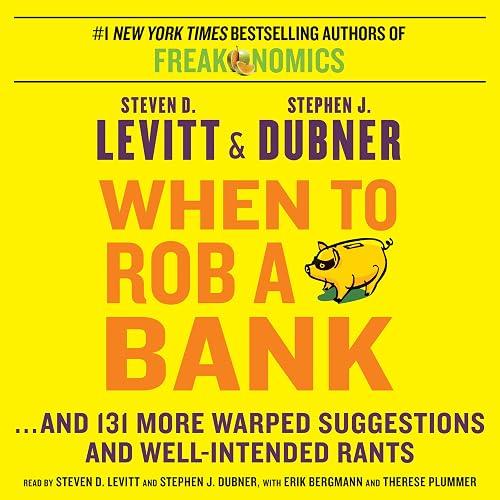
When To Rob A Bank is a collection of the best of the Freakonomics authors’ blog posts from over 10 years of blogging about economics in all areas of our life.
When To Rob A Bank is a collection of the best of the Freakonomics authors’ blog posts from over 10 years of blogging about economics in all areas of our life.
We all know the difference between 99 cents and a dollar is absolutely negligible, yet no one likes to buy $1-cheeseburgers when the restaurant next door offers them as $0.99ers. “Not even a dollar!!” we think and gone are our rational thinking capabilities.
In Germany, for years grocery store chains have been fighting a brand battle – the well-established names of frozen pizza, like Dr. Oetker, against the no-name, in-house brands of cheap discounters like Aldi or Lidl, for example. Even though we long know that these pizzas are the exact same (a friend of mine even worked at the factory and said they just change boxes), psychologically, we still fret about buying the cheap one over the brand we trust and know.
With generic drugs in the US, the problem is even bigger, where Walgreens and CVS might charge over $100 for a generic variant of Prozac, which costs $12 a bottle at Costco. Retirees just don’t compare prices. They assume they must be similar everywhere, so they just stop at their usual drug store.
This clearly looks like a business exploiting a knowledge gap, however, most of them have no clue about pricing either. For example, when Steven Levitt ate at a chicken restaurant, he realized the 3-wing meal cost $4.50, when the 2-wing meal with the same sides and drink cost just $3.03.
But hey, even governments screw up pricing: it costs by far more to make a penny than, well, a penny, but the US government keeps making them.
When it comes to pricing, most of us suck, so it’s well worth your time to learn something about it.
Here’s something environmentalists won’t want to hear: Depending on how far you go and what you eat, it can sometimes be better to take the car instead of walking. For example, if you walk 1.5 miles and then have just one glass of milk to replenish your energy, you’d have had less of a negative impact on the environment if you’d just taken the car, but skipped the milk. The reason is that producing a glass of milk takes a lot more energy and produces a lot more CO2 emissions than driving for such a short distance. This is because cows emit CO2, the milk production process does as well, and of course the milk has to get to your store and house too! Of course this is a funny example, but it just goes to show that when trying to do something for the environment,…
Continue reading in the MinuteRead app
Get the complete 5-minute summary of When To Rob A Bank
Get the complete summary in the appWhether we judge or make prices, our common sense flies right out the window.
If you drink a glass of milk after walking home, you could’ve taken the car and it’d have been better for the environment.
As long as it helps preserve our own self-image, we lie even when telling the truth would be a lot better for us.
"When To Rob A Bank" is a strong fit if you want practical ideas around communication skills, culture, economics, especially themes like whether we judge or make prices, our common sense flies right out the window; if you drink a glass of milk after walking home, you could’ve taken the car and it’d have been better for the environment. The MinuteRead summary distills these concepts into a focused read, whether you're deciding whether to buy the book or applying its lessons at work.
Continue Reading
Access the complete 5-minute summary and thousands more nonfiction books in the MinuteRead app.

Continue reading the complete summary in the MinuteRead app.