MinuteRead
30 min
Book summary
Premium summary · Opens in the app · 30 min read
We tell the story of innovation wrong. We celebrate the lone genius, the sudden flash of insight, the eureka moment that changes everything. Newton sits under an apple tree and gravity reveals itself. Archimedes steps into a bath and shouts the word that would echo through centuries. These stories make for good drama, but they distort how ideas actually come into being.
**By Steven Johnson**
**Estimated Reading Time:** 45 minutes
**What You'll Learn:** Why breakthrough ideas rarely arrive as sudden lightning strikes. How environments shape innovation more than individual genius. What coral reefs, cities, and the internet teach us about creativity. How to cultivate the conditions that make transformative ideas almost inevitable.
**Who This Book Is For:** Anyone who creates, builds, or solves problems for a living. Entrepreneurs tired of waiting for inspiration. Scientists and artists curious about the patterns behind discovery. Leaders who want to build teams and organizations where innovation flourishes. And anyone who has ever wondered why certain periods of history explode with creativity while others remain stagnant.
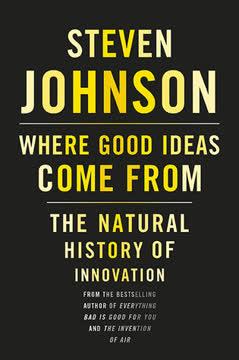
We tell the story of innovation wrong. We celebrate the lone genius, the sudden flash of insight, the eureka moment that changes everything. Newton sits under an apple tree and gravity reveals itself. Archimedes steps into a bath and shouts the word that would echo through centuries. These stories make for good drama, but they distort how ideas actually come into being. Steven Johnson spent years investigating the environments and patterns that generate breakthrough ideas. What he found contradicts much of what we believe about creativity. Good ideas do not arrive fully formed in a single moment of brilliance. They emerge slowly, built from fragments and hunches that sometimes take years to connect. They depend on the spaces we inhabit, the people we talk to, the seemingly random collisions between different domains of knowledge. Innovation, Johnson discovered, follows patterns that are almost ecological in nature. The central question driving this book is deceptively simple: What kind of environment makes good ideas more likely? Johnson approaches this question by looking at systems that generate extraordinary creativity and innovation. He examines coral reefs, which cover less than one percent of the ocean floor yet produce a staggering percentage of marine life. He studies cities, which have always been engines of human creativity despite their chaos and density. He traces the history of the internet, which has accelerated the pace of innovation to levels never before seen in human history. What these environments share is not obvious at first glance. A coral reef, a bustling city, and a digital network seem to have little in common. But Johnson identifies a pattern: all three are what he calls liquid networks. They are spaces where information flows freely, where diverse elements come into contact with one another, where the boundaries between different domains are porous enough to allow unexpected connections. In these environments, ideas collide, combine, and recombine in ways that generate novelty. This insight has profound implications for how we think about creativity. If innovation depends on environment more than individual genius, then the most…
Continue reading in the MinuteRead app
Get the complete 30-minute summary of Where Good Ideas Come From
Get the complete summary in the appGood ideas emerge from networks, not from isolated minds. Build better networks to have better ideas.
The adjacent possible defines what can be invented right now. Focus on the next step, not the distant future.
Liquid networks balance order and chaos. They are the environments where innovation flourishes.
Most breakthrough ideas are slow hunches that develop over years. Be patient with your partial ideas.
Serendipity can be cultivated. Increase the diversity of information flowing through your mind.
Error and noise are essential for innovation. Do not try to eliminate them entirely.
"Where Good Ideas Come From" is a strong fit if you want practical ideas around business, history, science—especially themes like good ideas emerge from networks, not from isolated minds. build better networks to have better ideas; the adjacent possible defines what can be invented right now. focus on the next step, not the distant future. The MinuteRead summary distills these concepts into a focused read, whether you're deciding whether to buy the book or applying its lessons at work.
Steven Johnson is a prolific author and media theorist known for his exploration of science, technology, and innovation. He has written twelve bestselling books, including "Where Good Ideas Come From" and "How We Got to Now." Johnson's work often examines the intersection of history, science, and culture, offering insights into how ideas and innovations shape society. In addition to his writing, Johnson hosts the podcast "American Innovations" and co-created a PBS/BBC series. He divides his time…
View all summaries by Steven JohnsonContinue Reading
Access the complete 30-minute summary and thousands more nonfiction books in the MinuteRead app.

Continue reading the complete summary in the MinuteRead app.