 MinuteRead
30 min
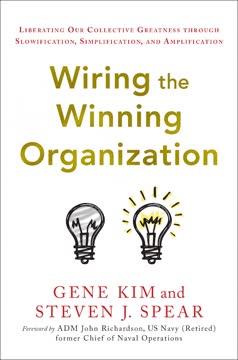
Every organization has a hidden architecture. It is not the org chart hanging on the wall or the mission statement printed in the employee handbook. It is the actual system by which work gets done: the paths information travels, the routines people follow, the unspoken rules about who talks to whom, and the processes that either enable or obstruct progress.
**Author:** Gene Kim
**Estimated Reading Time:** 42 minutes
**What You'll Learn:**
- Why some organizations consistently outperform others despite having similar talent and resources - The three core mechanisms that separate winning organizations from struggling ones - How leaders shape the invisible systems that determine success or failure - Practical frameworks for redesigning how work actually gets done - A 30-day implementation plan for transforming your organization's wiring
**Who This Book Is For:**
This book is for leaders who sense something is wrong in their organizations but cannot quite name it. It is for managers frustrated by brilliant people producing mediocre results. It is for engineers, operators, and team leads who feel trapped by processes that seem designed to prevent good work. And it is for anyone who has ever wondered why some teams seem to glide through complexity while others drown in it.
Every organization has a hidden architecture. It is not the org chart hanging on the wall or the mission statement printed in the employee handbook. It is the actual system by which work gets done: the paths information travels, the routines people follow, the unspoken rules about who talks to whom, and the processes that either enable or obstruct progress. Gene Kim calls this hidden architecture "social circuitry." And he argues that it, more than any other factor, determines whether an organization wins or loses. Think about two companies in the same industry, with similar budgets, similar talent, and similar technology. One consistently delivers innovative products, responds quickly to problems, and seems to hum with productive energy. The other struggles with delays, miscommunication, and recurring failures. The difference is rarely intelligence or effort. The difference is in how the organizations are wired. This insight emerged from Kim's decades of studying high-performing technology organizations. He noticed that the best companies did not simply hire better people or buy better tools. They created conditions where ordinary people could do extraordinary work. They built systems that made it easy to solve problems, coordinate efforts, and learn from mistakes. In short, they wired their organizations to win. The problem is that most leaders do not think in these terms. They focus on strategy, on hiring, on individual performance. They treat organizational design as a static exercise, something to be completed and then forgotten. But organizations are living systems. Their circuitry either improves over time or degrades. There is no standing still. When the wiring is bad, the symptoms are familiar. Decisions take forever. Information gets trapped in silos. Problems are hidden rather than surfaced. People spend more energy navigating bureaucracy than doing actual work. The best employees leave, not because the pay is bad, but because the friction is unbearable.…
Continue reading in the MinuteRead app
Get the complete 30-minute summary of Wiring the Winning Organization
Get the complete summary in the app**Social circuitry determines success.** The hidden architecture of processes, routines, and communication channels matt
**The danger zone is where complex problems meet poor coordination.** The winning zone is where simplified problems meet
**Slowification moves problem-solving from high-pressure environments to controlled environments.** Simulation, planning
**Simplification reduces coordination demands by breaking complex problems into manageable parts.** Incrementalization,
**Amplification ensures that problems are quickly identified and addressed.** Clear channels, rapid response, and root c
**The three mechanisms reinforce each other.** Integration is more powerful than any single mechanism.
"Wiring the Winning Organization" is a strong fit if you want practical ideas around business, leadership, management, especially themes like **social circuitry determines success.** the hidden architecture of processes, routines, and communication channels matt; **the danger zone is where complex problems meet poor coordination.** the winning zone is where simplified problems meet. The MinuteRead summary distills these concepts into a focused read, whether you're deciding whether to buy the book or applying its lessons at work.
Gene Kim is a renowned figure in the technology and DevOps world. As a multiple award-winning CTO and founder of Tripwire, he has made significant contributions to IT operations, security, and compliance. Kim co-authored Visible Ops and is known for his research in IT operations and security. His passion lies in transforming IT organizations from "good to great." With certifications as an IS auditor and expertise in the Theory of Constraints, Kim brings a multifaceted perspective to his work. Hi…
View all summaries by Gene KimContinue Reading
Access the complete 30-minute summary and thousands more nonfiction books in the MinuteRead app.

Continue reading the complete summary in the MinuteRead app.






