MinuteRead
30 min
Book summary
by Linda Elder
Premium summary · Opens in the app · 30 min read
Every day you make thousands of decisions. Most are small: what to eat, what to wear, which route to take to work. But some are enormous: whether to trust a news report, how to respond to a difficult colleague, what to believe about a political candidate, how to raise your children, what kind of person you want to become.
**Author:** Linda Elder
**Estimated Reading Time:** 45 minutes
**What You'll Learn:** How to systematically improve the quality of your thinking, recognize the hidden patterns that distort your judgment, and apply critical thinking to every dimension of your life.
**Who This Book Is For:** Anyone who has ever made a decision they regretted, held a belief they couldn't defend, reacted emotionally and wished they hadn't, or suspected that their thinking might be the very thing holding them back.
Every day you make thousands of decisions. Most are small: what to eat, what to wear, which route to take to work. But some are enormous: whether to trust a news report, how to respond to a difficult colleague, what to believe about a political candidate, how to raise your children, what kind of person you want to become. Beneath every one of these decisions lies a hidden architecture of thought. You rarely notice it. You rarely examine it. And yet it determines everything. The central claim of this book is both simple and radical: the quality of your life is determined by the quality of your thinking. Not your circumstances. Not your luck. Not your background. Your thinking. This is not a feel-good slogan. It is a practical observation about how human beings operate. Your thoughts shape how you interpret events. Your interpretations shape your emotions. Your emotions shape your actions. Your actions shape your relationships, your career, your health, and your sense of meaning. Change the thinking, and everything downstream changes with it. The problem is that most people never learn to think about their thinking. They inherit beliefs from their families and cultures without questioning them. They react emotionally to situations without understanding why. They make decisions based on assumptions they have never surfaced. They consume media without analyzing the messages embedded within it. They argue to win rather than to understand. This is not because they are unintelligent. It is because no one taught them how to think critically. Schools teach students what to think, not how to think. Parents pass down conclusions without passing down the reasoning behind them. Society rewards confidence and certainty, not careful reflection and intellectual humility. The result is a world full of people who are certain about things they have never examined, angry about situations they misunderstand, and trapped in patterns of thought they cannot see. Linda Elder offers a different path. As an educational psychologist and president of the Foundation for Critical Thinking, she has spent decades studying how people think, why they think poorly, and what they can do to think better. Her approach is not abstract philosophy. It is a practical, daily practice of examining your own mind. The book…
Continue reading in the MinuteRead app
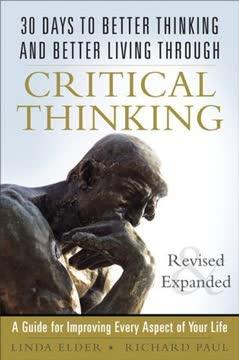
Get the complete 30-minute summary of 30 Days to Better Thinking and Better Living Through Critical Thinking
Get the complete summary in the appThe quality of your life is determined by the quality of your thinking.
Question your assumptions. They are usually invisible and often wrong.
Distinguish inferences from facts. What you think you see is often an interpretation.
Cultivate intellectual humility. You are often wrong. Be willing to change your mind.
Practice empathy. Understand others' perspectives, especially those you disagree with.
Recognize that emotions are generated by thoughts. Change the thinking, change the feeling.
"30 Days to Better Thinking and Better Living Through Critical Thinking" is a strong fit if you want practical ideas around self help, ebooks, philosophy, especially themes like the quality of your life is determined by the quality of your thinking; question your assumptions. they are usually invisible and often wrong. The MinuteRead summary distills these concepts into a focused read, whether you're deciding whether to buy the book or applying its lessons at work.
Dr. Linda Elder is an educational psychologist specializing in critical thinking. As President of the Foundation for Critical Thinking and Executive Director of the Center for Critical Thinking, she has extensive experience teaching and presenting on the subject. Elder has co-authored several books and thinker's guides on critical thinking, and developed an original stage theory of critical thinking development. Her work focuses on understanding the relationship between thinking and affect, as w…
View all summaries by Linda ElderContinue Reading
Access the complete 30-minute summary and thousands more nonfiction books in the MinuteRead app.

Continue reading the complete summary in the MinuteRead app.