MinuteRead
30 min
Book summary
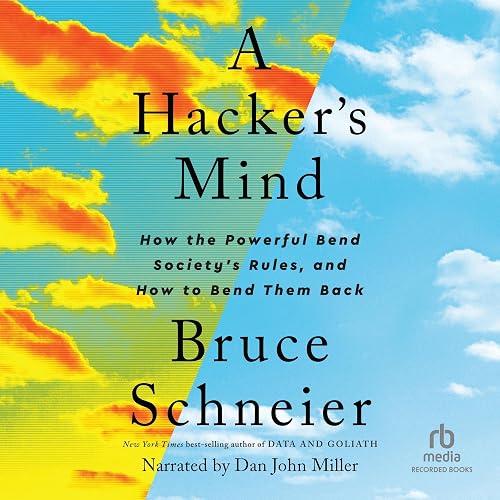
by Bruce Schneier
Premium summary · Opens in the app · 30 min read
We tend to think of hackers as shadowy figures in dark rooms, fingers flying across keyboards, breaking into computer networks. The image is cinematic but incomplete. Bruce Schneier, one of the world's foremost security experts, argues that hacking is something far more pervasive and far more important than computer intrusion. Hacking is a way of thinking. It is the art of finding unexpected paths through systems, of exploiting rules in ways their designers never anticipated. And it happens ever
**Author:** Bruce Schneier **Estimated Reading Time:** 42 minutes
The hidden mechanics of how systems are exploited, why the wealthy and powerful are the most skilled hackers, and how artificial intelligence will transform the landscape of rule-breaking in ways we are only beginning to understand.
Anyone who has ever wondered why the rich seem to play by different rules, why technology feels increasingly manipulative, or how the clever subversion of systems shapes everything from tax policy to social media feeds. This is for readers who want to see the hidden architecture of modern power.
We tend to think of hackers as shadowy figures in dark rooms, fingers flying across keyboards, breaking into computer networks. The image is cinematic but incomplete. Bruce Schneier, one of the world's foremost security experts, argues that hacking is something far more pervasive and far more important than computer intrusion. Hacking is a way of thinking. It is the art of finding unexpected paths through systems, of exploiting rules in ways their designers never anticipated. And it happens everywhere. Consider the tax code. It is a system, a vast collection of rules designed to fund public goods. Now consider the accountant who discovers that a particular corporate structure allows a client to avoid paying taxes on certain income. The accountant has not broken any law. The structure is legal. But the outcome, the avoidance of taxes, subverts the intent of the system. That is a hack. Consider the athlete who discovers that a particular movement, not prohibited by the rules, gives an unfair advantage. The athlete has not cheated in the traditional sense. The rules do not forbid the movement. But the spirit of the game has been violated. That is a hack. Consider the social media platform that designs its notification system to exploit the brain's dopamine response, keeping users scrolling long after they intended to stop. The platform has not forced anyone to do anything. But it has manipulated human psychology to achieve an outcome that benefits the platform at the user's expense. That is a hack. Schneier's central insight is that hacking is not a niche activity performed by criminals and computer geeks. It is a fundamental feature of all complex systems. Any system with rules will have people who find ways to subvert those rules without technically breaking them. This is true of financial markets, legal codes, political processes, and increasingly, the human mind itself. The problem is that not all hacks are created equal. Some hacks are harmless, even beneficial. They reveal flaws in systems and force improvements. They drive innovation. The cyclist who discovers a more aerodynamic riding position is hacking the rules of physics and the conventions of the sport.…
Continue reading in the MinuteRead app
Get the complete 30-minute summary of A Hacker's Mind
Get the complete summary in the appA hack is the clever exploitation of a gap between a system's rules and its intended purpose.
Hacking happens everywhere, not just in computers. Financial systems, legal codes, political processes, and human minds
The wealthy and powerful are the most skilled hackers because they have the resources to find vulnerabilities and the in
Many standard practices began as hacks that became accepted over time.
Cognitive hacks exploit mental shortcuts to manipulate attention, trust, and fear. Digital technology has made these hac
AI hacking is fundamentally different from human hacking. AI systems can find vulnerabilities that humans would never no
"A Hacker's Mind" is a strong fit if you want practical ideas around technology, computer science, politics, especially themes like a hack is the clever exploitation of a gap between a system's rules and its intended purpose; hacking happens everywhere, not just in computers. financial systems, legal codes, political processes, and human minds. The MinuteRead summary distills these concepts into a focused read, whether you're deciding whether to buy the book or applying its lessons at work.
Motivated to help readers with hack is more likely in a corporate office, Bruce Schneier wrote “A Hacker's Mind” to package those ideas for a fast, focused read. Through “A Hacker's Mind”, Bruce Schneier distills the core ideas on technology into lessons readers can absorb in a single short sitting. Readers turn to this work when they want Bruce Schneier's perspective on the subject without working through the entire original volume. The book is structured so each chapter highlights a practical …
Continue Reading
Access the complete 30-minute summary and thousands more nonfiction books in the MinuteRead app.

Continue reading the complete summary in the MinuteRead app.