MinuteRead
30 min
Book summary
by John Steele Gordon
Premium summary · Opens in the app · 30 min read
Every empire in history has announced itself with armies. Rome marched legions across three continents. Britain ruled a quarter of the globe's people through naval power and colonial administration. The Soviet Union held its territory with tanks and secret police. Power, we have been taught, flows from the barrel of a gun.
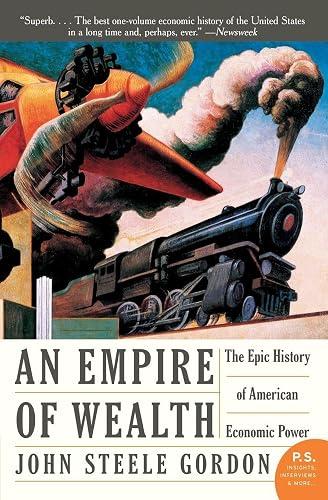
### The Epic History of American Economic Power
**Author:** John Steele Gordon
**Estimated Reading Time:** 45 minutes
**What You'll Learn:**
How a collection of struggling colonies became the greatest economic engine in human history, why American influence spread through desire rather than conquest, and what the nation's financial history reveals about the true sources of prosperity.
**Who This Book Is For:**
Anyone who wants to understand the deep economic forces that shaped America, from the role of law and property rights to the scandals that built modern capitalism, and why the American model of wealth creation remains unique in world history.
Every empire in history has announced itself with armies. Rome marched legions across three continents. Britain ruled a quarter of the globe's people through naval power and colonial administration. The Soviet Union held its territory with tanks and secret police. Power, we have been taught, flows from the barrel of a gun. America tells a different story. With just 6 percent of the world's land and roughly 5 percent of its population, the United States commands approximately 30 percent of global economic output, more than triple its nearest rival. American cultural products saturate the planet. Blue jeans made in factories across Asia carry American brand names. Hollywood films dominate box offices from Mumbai to Mexico City. The English language has become the default tongue of international commerce and science. The Internet, an American invention, now connects half of humanity. None of this was achieved through conquest. The United States never sought to rule foreign populations. It annexed no great territories after its wars of the twentieth century. It stationed no colonial governors in distant capitals. Yet its influence penetrates deeper than any occupying army ever managed. John Steele Gordon's central insight is that America built a new kind of empire, an empire of wealth. Its power rests not on coercion but on attraction. People around the world adopt American ways not because they are forced to, but because they want what America has. They want the prosperity, the freedom, the material abundance, and the cultural vitality that the American economic system produces. This is a conquest more subtle and more permanent than any before it. Armies can be defeated. Occupations can be resisted. But desire cannot be suppressed by force. When people genuinely want what you offer, when they voluntarily reshape their lives around your products, your language, and your ideas, you have achieved something no military campaign could ever accomplish. The question is how this happened. What made America different? Why did the United States, alone among the nations of the Americas, become an economic superpower while Argentina, blessed with comparable natural resources, stagnated? Why did American capitalism…
Continue reading in the MinuteRead app
Get the complete 30-minute summary of An Empire of Wealth
Get the complete summary in the appAmerica's empire was built on wealth, not weapons. Its influence spreads through desire, not conquest.
Secure property rights and the supremacy of law are the foundation of prosperity. Institutions matter more than resource
Labor scarcity drove both American innovation and American slavery. The same force produced the best and worst of Americ
Government credit is a national asset. Hamilton built the world's best credit rating from worthless debt.
Destroying the central bank caused 80 years of financial panics. Institutional vacuums generate systemic fragility.
Collapsing transaction costs transforms economies. The Erie Canal made New York the commercial capital of the continent.
"An Empire of Wealth" is a strong fit if you want practical ideas around history, economics, business, especially themes like america's empire was built on wealth, not weapons. its influence spreads through desire, not conquest; secure property rights and the supremacy of law are the foundation of prosperity. institutions matter more than resource. The MinuteRead summary distills these concepts into a focused read, whether you're deciding whether to buy the book or applying its lessons at work.
Motivated to turn hard-won expertise into something readers can use every day, John Steele Gordon wrote “An Empire of Wealth” to distill the ideas behind the work into clear, actionable lessons. Through “An Empire of Wealth”, John Steele Gordon distills the core ideas on history into lessons readers can absorb in a single short sitting. Readers turn to this work when they want John Steele Gordon's perspective on the subject without working through the entire original volume. The book is structur…
Continue Reading
Access the complete 30-minute summary and thousands more nonfiction books in the MinuteRead app.

Continue reading the complete summary in the MinuteRead app.