MinuteRead
30 min
Book summary
by Nassim Taleb
Premium summary · Opens in the app · 5 min read
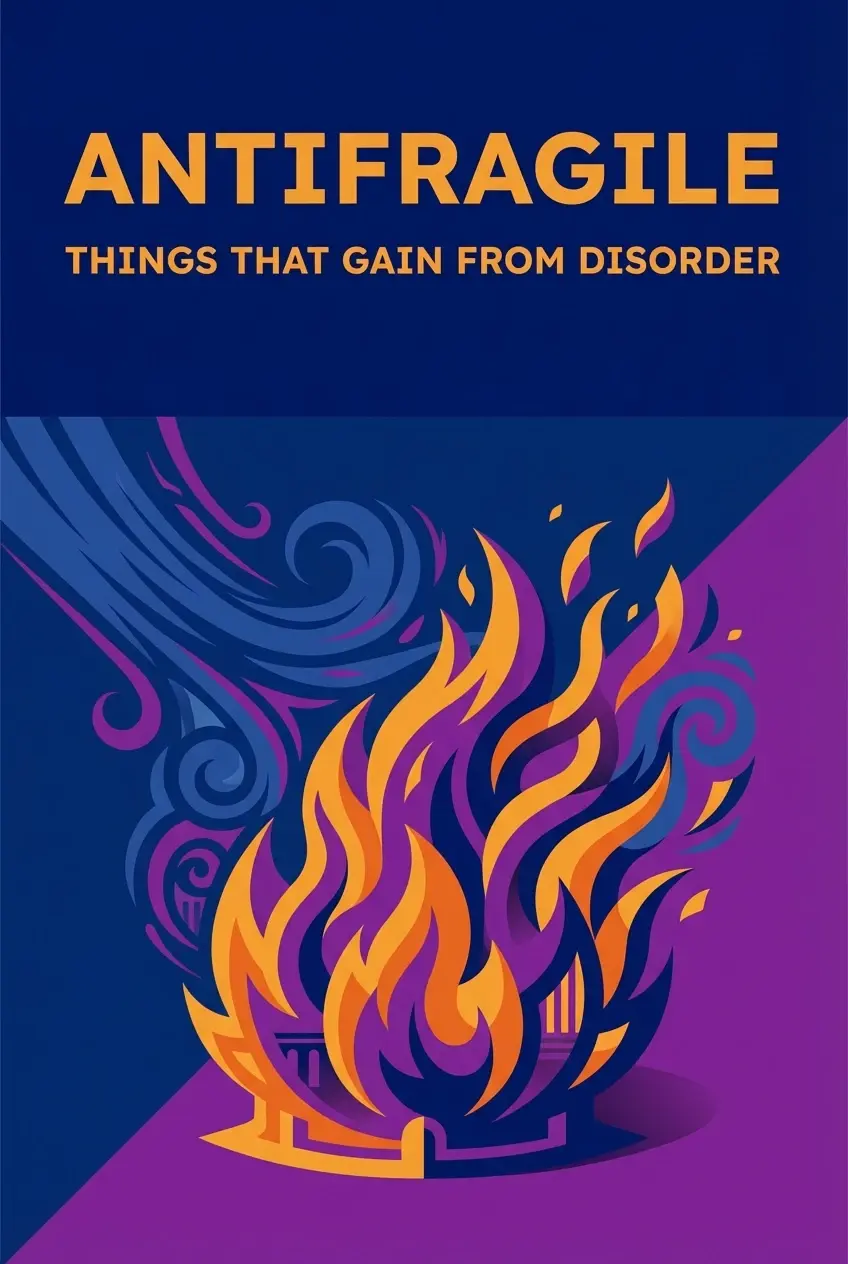
Antifragile reveals how some systems thrive from shocks, volatility and uncertainty, instead of breaking from them, and how you can adapt more antifragile traits yourself to thrive in an uncertain and chaotic world.
Antifragile reveals how some systems thrive from shocks, volatility and uncertainty, instead of breaking from them, and how you can adapt more antifragile traits yourself to thrive in an uncertain and chaotic world.
We all know the label on boxes with glass inside them that reads “Fragile – handle with care”, and we’ve all seen more than one scene in a movie where someone throws a package like that, resulting in a glass shattering noise.
You know that fragile things break when you shock them and toss them around – volatility does them no good.
But when you think about it, there isn’t really a word that describes things, which are the opposite, is there?
We might talk about something being robust or durable, but that really just means it can resist shocks and stress better than fragile items – but it doesn’t benefit from them.
You’d still label the boxes you ship robust things in with “Handle with care”, not with “Please handle roughly”.
Nassim Taleb took care of this dilemma by giving us a word for what we’re looking for: antifragile.
It describes things that benefit from shock and thrive in volatile environments, because as they’re stressed and put under pressure, they get better, not worse.
Can you think of an example?
Tough, right?
Here’s one: When Hercules fights the Hydra, every time he slices off one of her heads, two grow back.
So for every time the beast is hurt, it actually gets stronger. That’s an example of being antifragile.
There are quite a few more good examples of antifragile systems, one being the evolutionary process.
Evolution itself is incredibly antifragile – we’ve evolved from our ancestors based on the genetic features and traits which helped us survive the most and succeed.
However, that also meant many humans before us had to die.
Any individual specimen of a species is usually fragile – every human being or animal can die and quite easily so.
But, because the system can use life and death as indicators of success and failure, the evolution of species in itself is antifragile.
For example, our hands weren’t always built to handle tools so well.
Through evolution it became apparent that the more advanced our hands got, the longer we could survive, so eventually our genetic code morphed to include the incredibly refined hands we all have today.
So for an antifragile system to work, its individual parts must be fragile, because the success and failure of these parts serves as important feedback for the system as a whole and allows it to get better in chaotic circumstances.
Continue reading in the MinuteRead app
Get the complete 5-minute summary of Antifragile
Get the complete summary in the appFragile items break under stress, antifragile items get better from it.
An antifragile system usually consists of many fragile parts.
Antifragile systems work, because they build extra capacity when put under stress.
"Antifragile" is a strong fit if you want practical ideas around personal finance, business, economics, especially themes like fragile items break under stress, antifragile items get better from it; an antifragile system usually consists of many fragile parts. The MinuteRead summary distills these concepts into a focused read, whether you're deciding whether to buy the book or applying its lessons at work.
Motivated to help readers with antifragile reveals how some systems thrive from shocks, Nassim Taleb is about systems that thrive in adversity wrote “Antifragile” to package those ideas for a fast, focused read. In “Antifragile”, Nassim Taleb is about systems that thrive in adversity focuses on antifragile reveals how some systems thrive from shocks. Through “Antifragile”, Nassim Taleb is about systems that thrive in adversity distills the core ideas on personal finance into lessons readers can …
View all summaries by Nassim TalebContinue Reading
Access the complete 5-minute summary and thousands more nonfiction books in the MinuteRead app.

Continue reading the complete summary in the MinuteRead app.