MinuteRead
30 min
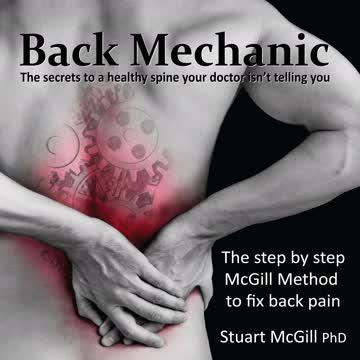
Book summary
Premium summary · Opens in the app · 30 min read
Back pain is one of the most common human complaints. It affects people across every age group, every profession, and every level of physical fitness. It costs billions in lost productivity and medical expenses. Yet despite its prevalence, back pain remains widely misunderstood. Most people receive advice that is either too vague to be useful or too generic to address their specific situation.
**Author:** Stuart McGill, PhD
**Estimated Reading Time:** 45 minutes
**What You'll Learn:**
- Why most back pain is not a mystery, and how to identify its true cause - How to assess your own pain triggers without expensive equipment - The exercises that build spinal stability without causing further damage - How to move through daily life without aggravating your back - How to create a personalized recovery plan that actually works
**Who This Book Is For:**
Anyone who has experienced back pain, whether it is a dull ache after sitting at a desk or a sharp spasm that stops you in your tracks. This book is for people who have tried generic advice and found it lacking. It is for those who want to understand their own body rather than simply treating symptoms. If you have been told your back pain is "non-specific" or that you just have to live with it, this book will change how you think about your spine.
Back pain is one of the most common human complaints. It affects people across every age group, every profession, and every level of physical fitness. It costs billions in lost productivity and medical expenses. Yet despite its prevalence, back pain remains widely misunderstood. Most people receive advice that is either too vague to be useful or too generic to address their specific situation. The standard approach to back pain often looks like this. You visit a doctor. You may get an MRI. You are told something about degeneration or wear and tear. You are given pain medication and perhaps a referral to physical therapy. You are told to stretch more, strengthen your core, and avoid heavy lifting. If the pain persists, you might try yoga, pilates, chiropractic care, acupuncture, or any number of alternative treatments. Some things help temporarily. Some make things worse. The pain returns. You begin to believe that back pain is simply something you must live with. Stuart McGill has spent over three decades studying the spine. His laboratory at the University of Waterloo has produced some of the most influential research on how the back functions, how it gets injured, and how it heals. He has worked with elite athletes, manual laborers, office workers, and people who have suffered from back pain for decades. His conclusion is simple and, for many people, revolutionary: back pain is almost never random. There is always a cause. And once you identify that cause, you can begin to fix it. The problem with most back pain treatment is not a lack of effort. It is a lack of precision. People are given exercises without understanding why they are doing them. They are told to stretch without knowing…
Continue reading in the MinuteRead app
Get the complete 30-minute summary of Back Mechanic
Get the complete summary in the appYour back pain has a specific cause. Find it.
You are the best judge of your own pain. Trust your experience.
The core muscles that protect your spine need endurance, not strength.
The Big Three exercises are the modified curl-up, the side bridge, and the bird-dog.
Spine hygiene matters more than exercise. Change how you move throughout the day.
Use the hip hinge whenever you bend or lift.
"Back Mechanic" is a strong fit if you want practical ideas around health & fitness, health, fitness, especially themes like your back pain has a specific cause. find it; you are the best judge of your own pain. trust your experience. The MinuteRead summary distills these concepts into a focused read, whether you're deciding whether to buy the book or applying its lessons at work.
Stuart McGill, PhD is a renowned expert in spine function, injury prevention, and rehabilitation. As a professor at the University of Waterloo, he has published extensively on lumbar function and low back injury mechanisms. His work has earned him international recognition, including the Volvo Bioengineering Award. McGill has lectured worldwide and consulted for various organizations, including government agencies, corporations, and professional sports teams. His expertise in assessing and reduc…
View all summaries by Stuart McGillContinue Reading
Access the complete 30-minute summary and thousands more nonfiction books in the MinuteRead app.

Continue reading the complete summary in the MinuteRead app.