MinuteRead
30 min
Book summary
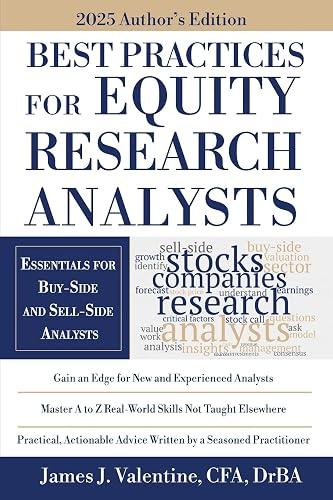
by James J. Valentine
Premium summary · Opens in the app · 30 min read
Equity research looks glamorous from the outside. Analysts appear on television, publish reports that move markets, and command seven-figure compensation packages. The work seems intellectual, prestigious, and exciting. And it is. But beneath the surface lies a profession with surprisingly few standards.
**Author:** James J. Valentine
**Estimated Reading Time:** 45 minutes
**What You'll Learn:**
- How to manage your time and coverage universe for maximum analytical depth - How to identify the critical factors that actually move stock prices - How to build proprietary information networks that give you an edge - How to apply quantitative tools and forensic accounting to improve forecasts - How to overcome the psychological biases that sabotage investment decisions - How to communicate your research so it actually influences decision-makers
**Who This Book Is For:**
This book is for equity research analysts on both the buy-side and sell-side, portfolio managers who consume research, and anyone who wants to understand how professional investors develop an analytical edge. Whether you are early in your career or a seasoned analyst looking to refine your process, the frameworks and practices here will help you work smarter, think more clearly, and communicate with greater impact.
Equity research looks glamorous from the outside. Analysts appear on television, publish reports that move markets, and command seven-figure compensation packages. The work seems intellectual, prestigious, and exciting. And it is. But beneath the surface lies a profession with surprisingly few standards. When James Valentine began his career as an equity research analyst, he discovered something troubling. Unlike law, medicine, or accounting, equity research had no established best practices. There was no bar exam, no board certification, no formal quality control process. Analysts learned on the job, often by trial and error, and the quality of their work varied enormously. Some analysts developed sophisticated processes that produced consistently good calls. Others floundered, relying on intuition and hope rather than systematic analysis. This absence of professional standards creates a real problem. Investors depend on equity research to make decisions about where to allocate capital. Pension funds, mutual funds, and individual investors all rely on the work of analysts to understand companies, industries, and valuations. When analysts do their jobs poorly, the consequences ripple through the entire financial system. When they do their jobs well, they help markets function efficiently and create genuine value for investors. The challenge is that equity research is genuinely difficult. Analysts must understand complex businesses, forecast future performance, assess competitive dynamics, and communicate their views persuasively. They must do all of this under intense time pressure, with incomplete information, and in markets that are constantly changing. The margin for error is small, and the competition is fierce. Valentine wrote this book to address a simple question: What separates great analysts from average ones? After years of working at top investment banks, including Morgan Stanley, and observing hundreds of analysts, he concluded that the answer is not raw intelligence or access to better information. The…
Continue reading in the MinuteRead app
Get the complete 30-minute summary of Best Practices for Equity Research Analysts
Get the complete summary in the app**Time is your most valuable resource.** Spend it on activities that generate alpha, not on busywork.
**Cover fewer stocks more deeply.** Aim for 35-50 names on the buy-side, 15-20 per team on the sell-side.
**Identify 2-4 critical factors for each stock.** These are the variables that will actually move the price.
**Build proprietary information networks.** The best insights come from customers, suppliers, competitors, and experts.
**Use the Automate, Delegate, or Outsource Decision Tree.** Do not do tasks yourself that others can do adequately.
**Use the FaVeS framework.** Identify where you have an edge: Forecast, Valuation, or Sentiment.
"Best Practices for Equity Research Analysts" is a strong fit if you want practical ideas around finance, business, reference, especially themes like **time is your most valuable resource.** spend it on activities that generate alpha, not on busywork; **cover fewer stocks more deeply.** aim for 35-50 names on the buy-side, 15-20 per team on the sell-side. The MinuteRead summary distills these concepts into a focused read, whether you're deciding whether to buy the book or applying its lessons at work.
Motivated to help readers with time is an analyst's most valuable resource and will be the weapon to provide competitive advantage, James J. Valentine wrote “Best Practices for Equity Research Analysts” to package those ideas for a fast, focused read. In “Best Practices for Equity Research Analysts”, James J. Valentine focuses on time is an analyst's most valuable resource and will be the weapon to provide competitive advantage. Through “Best Practices for Equity Research Analysts”, James J. Val…
Continue Reading
Access the complete 30-minute summary and thousands more nonfiction books in the MinuteRead app.

Continue reading the complete summary in the MinuteRead app.