MinuteRead
30 min
Book summary
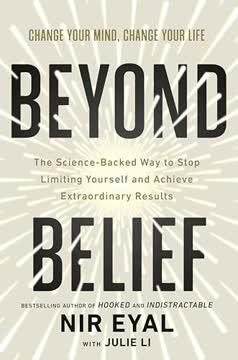
by Nir Eyal
Premium summary · Opens in the app · 30 min read
Nir Eyal spent thirty years failing at diets. Not failing in the way you might expect. He knew what to eat. He understood calories, macronutrients, and the science of metabolism. He could explain the mechanisms of low-fat diets, ketogenic diets, and intermittent fasting with the fluency of someone who had studied them all. Every plan he adopted worked brilliantly for a while. Then, inevitably, it stopped working. Not because the plan was flawed. Not because his body changed. But because somethin
**Author:** Nir Eyal
**Estimated Reading Time:** 45 minutes
**What You'll Learn:** How your beliefs shape what you notice, what you feel, and what you do. You'll discover why some people persist while others quit, how expectations physically alter your experience of reality, and practical methods for choosing beliefs that expand rather than limit your life.
**Who This Book Is For:** Anyone who has ever abandoned a goal despite knowing what to do, anyone curious about why two people can experience the same event so differently, and anyone ready to stop fighting their own mind and start working with it.
Nir Eyal spent thirty years failing at diets. Not failing in the way you might expect. He knew what to eat. He understood calories, macronutrients, and the science of metabolism. He could explain the mechanisms of low-fat diets, ketogenic diets, and intermittent fasting with the fluency of someone who had studied them all. Every plan he adopted worked brilliantly for a while. Then, inevitably, it stopped working. Not because the plan was flawed. Not because his body changed. But because something quieter happened: doubt crept in. The moment he stopped believing the diet would work, it stopped working. His behavior collapsed. His motivation evaporated. He quit. And then he found another plan, believed in it completely, and repeated the cycle. This pattern puzzled him for decades. He assumed the problem was the diets themselves. Each one must have been wrong in some way, insufficient, unsustainable. But the real problem was hiding in plain sight. The variable that changed between success and failure was never the food. It was his belief. This book is an investigation into that hidden variable. It asks a question most of us never think to ask: what if our beliefs are not simply reflections of reality but active forces that shape reality itself? The stakes are higher than dieting. Beliefs determine whether we notice opportunities or walk past them. They influence how much pain we feel, how quickly we heal, how long we live. They decide whether we persist through difficulty or quit before our efforts can pay off. They shape our relationships, our careers, and our sense of what is possible. Most of us treat beliefs as conclusions. We gather evidence, weigh it carefully, and arrive at a belief. We assume the process runs from reality to belief. But the evidence from psychology and neuroscience suggests something far stranger: the process often runs the other way. Beliefs filter what we notice. They shape what we feel. They drive what we do. In a very real sense, we live inside beliefs. This creates a problem. If beliefs are conclusions, then changing them requires new evidence. But if…
Continue reading in the MinuteRead app
Get the complete 30-minute summary of Beyond Belief
Get the complete summary in the appBeliefs are not facts. They are tools you can choose, evaluate, and replace.
Your brain filters eleven million bits of information down to fifty every second. Beliefs decide what you notice.
Expectations produce measurable physiological changes. What you expect shapes what you feel.
Most failures are caused by quitting, not by mistakes. And quitting is caused by the collapse of belief.
Passivity is the brain's default. Agency must be built through action, not thought.
Fantasizing about success sedates rather than motivates. Pair dreams with obstacles using mental contrasting.
"Beyond Belief" is a strong fit if you want practical ideas around psychology, self help, personal development, especially themes like beliefs are not facts. they are tools you can choose, evaluate, and replace; your brain filters eleven million bits of information down to fifty every second. beliefs decide what you notice. The MinuteRead summary distills these concepts into a focused read, whether you're deciding whether to buy the book or applying its lessons at work.
Nir Eyal is a bestselling author known for Hooked: How to Build Habit-Forming Products (2014 Goodreads Choice Awards finalist) and Indistractable: How to Control Your Attention and Choose Your Life (2019 nominee). He has taught at Stanford Graduate School of Business and the Hasso Plattner Institute of Design, bringing behavioral science expertise to technology and psychology. His work appears in Harvard Business Review, The Atlantic, TechCrunch, and Psychology Today, translating research into p…
View all summaries by Nir EyalContinue Reading
Access the complete 30-minute summary and thousands more nonfiction books in the MinuteRead app.

Continue reading the complete summary in the MinuteRead app.